
Property valuations
Will an online house valuation lead to sales calls?
Wanting to know your home's value does not mean you are ready for agent calls. Before submitting a valuation form, check what information is required, how it will be used and whether an agent enquiry is part of the service.
This is an estimate from comparable sales, not a RICS or mortgage valuation, and not a survey.
Read what the form is asking you to agree to
A postcode, email address and phone number serve different purposes. The address identifies the property. An email may deliver a report or provide account access. A phone number may support an enquiry, but you should not have to guess how it will be used.
Look around the submit button and any contact preferences, not just the large headline. Is the form requesting an estimate, asking an agent to contact you or doing both? Those are different experiences even if each page uses the word valuation.
The Information Commissioner's direct marketing checklist tells organisations to give privacy information when collecting information and explain their intended marketing activities. Your practical response is to look for that explanation before sending your details.
Four questions worth asking
First, who receives the details? Identify the business collecting them and whether other organisations are involved. An unclear reference to partners is a reason to ask for clarification rather than assume a particular referral arrangement.
Second, what contact is necessary to deliver the service? A confirmation or report-delivery message is different from a sales follow-up. Ask the provider to distinguish them.
Third, what choices do you have? Look for the available settings and record the choices you make. Do not assume that paying for a report establishes any particular privacy arrangement.
Fourth, where can you change your preferences or raise a concern later? Keep the relevant contact or account route. A privacy explanation is more useful when you can act on it.
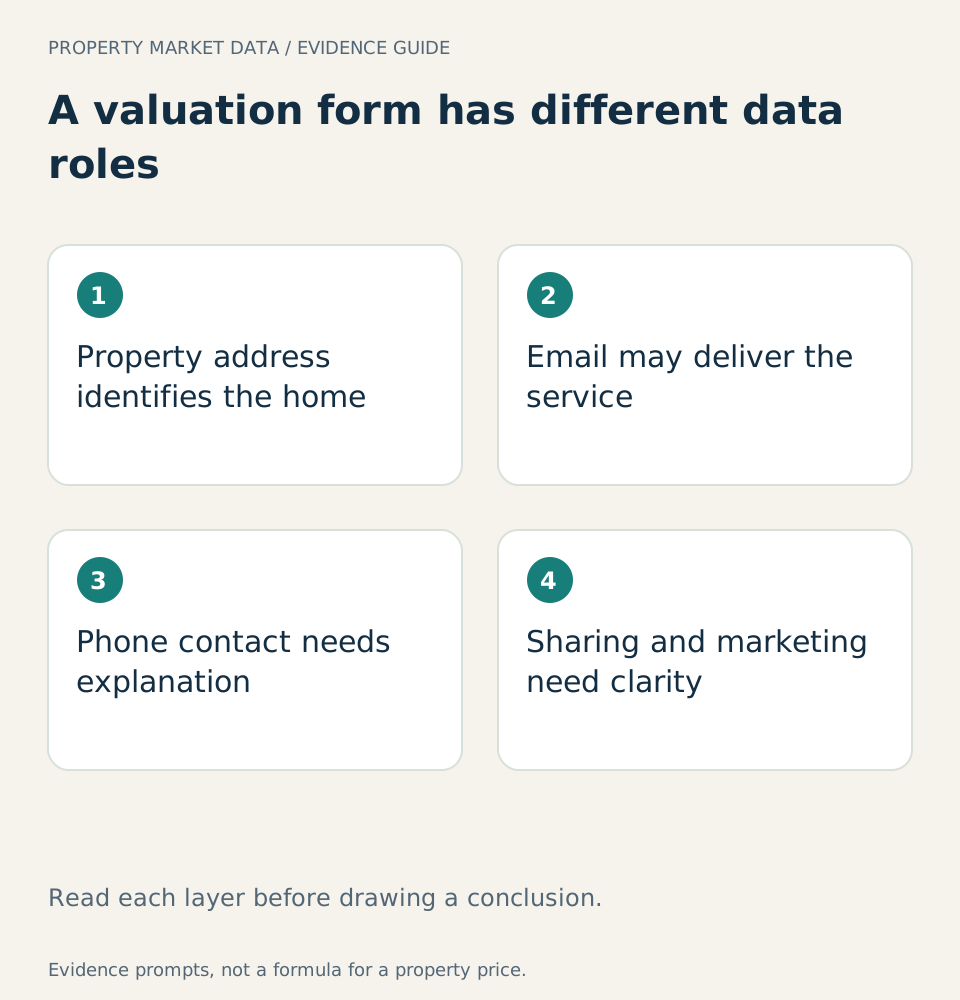
Property address identifies the home; Email may deliver the service; Phone contact needs explanation; Sharing and marketing need clarity. Read the evidence together before making a property-specific judgement.
Do not confuse privacy with service quality
An anonymous result may be convenient, but it still needs suitable property evidence. A service that requests contact details is not automatically a poor estimate. These are separate checks.
If you mainly want to avoid a home appointment, read how to research a valuation without an agent visit. If you are comparing a paid service, use how to compare valuation costs and deliverables. Neither decision should be made from a privacy claim alone.
A practical comparison sheet can include the estimate's explanation on one side and the contact process on the other. You can then choose knowingly instead of accepting whichever site makes the shortest promise.
Keep a record of your enquiry
Our suggestion is to retain the confirmation email and a note of what you requested. If unexpected contact follows, you can explain the distinction between the service enquiry and the marketing you did not intend to request.
Check the sender before following links or supplying further information. Use the provider's published contact route if something is unclear. Avoid sending identity documents in response to an unexplained follow-up simply because it mentions your home.
Inspect the enquiry journey
| Check | What to establish |
|---|---|
| First screen | Record which details are required before any result is shown. |
| Permission wording | Read whether contact relates to delivery, marketing or another service. |
| Named recipients | Check whether your details leave the website for another organisation. |
| After submission | Keep the privacy information and a record of the options selected. |
A request for a telephone number does not by itself tell you how that number will be used. Equally, a website without a telephone field may still collect other personal information. Judge the actual explanation and choices. If the next screen changes the terms, pause and read it before completing the enquiry.
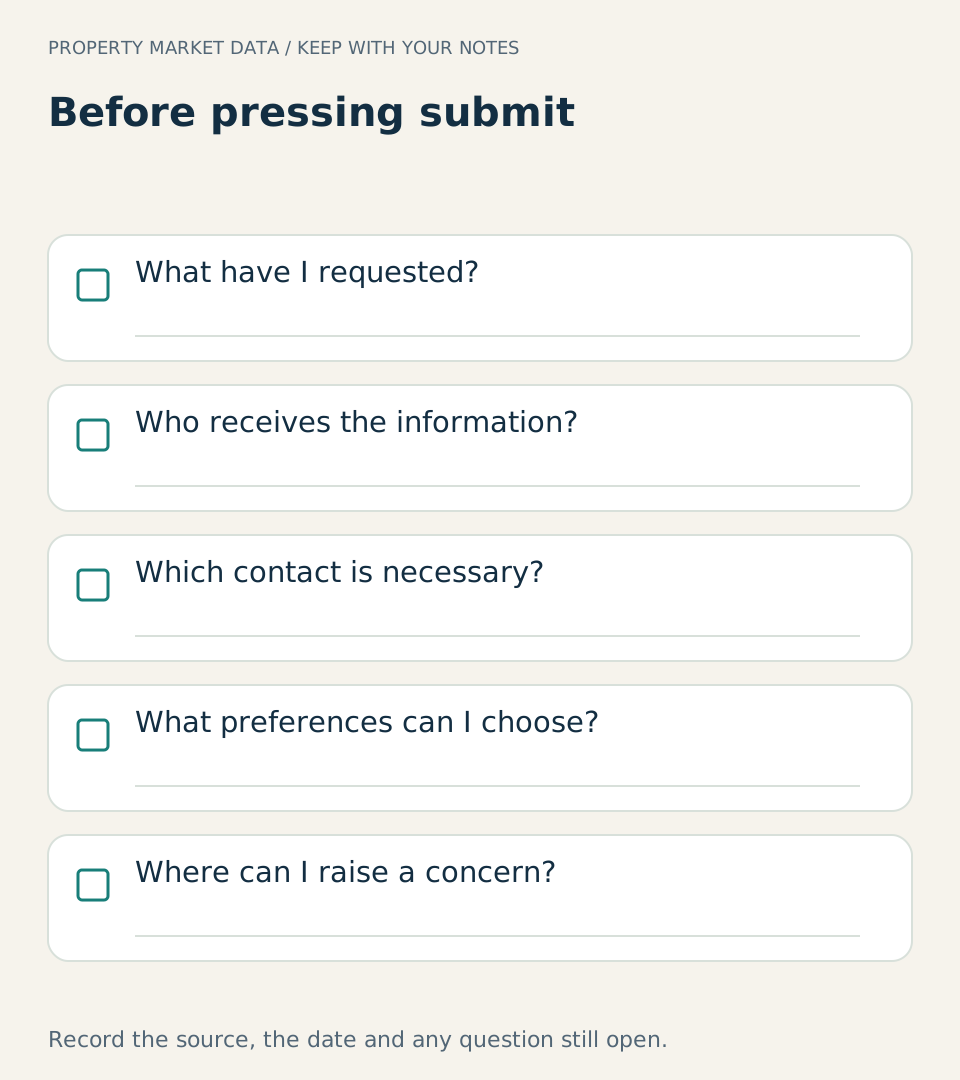
What have I requested?; Who receives the information?; Which contact is necessary?; What preferences can I choose?; Where can I raise a concern? Record the supporting document and any unanswered question.
Check PMD's process before ordering
PMD's published Privacy Notice distinguishes service messages from marketing. It also states that buying a report does not, by itself, authorise passing your details to an estate agent for marketing. A separate request for contact or a lead-sharing journey should explain the recipient and purpose before sharing. Check the notice and the choices shown during your order; do not infer that account access or report delivery requires no personal information.
A PMD report can help organise comparable evidence for your property decision. Contact preferences and the nature of that report are separate matters. If a human assessment is your concern, consider when a second property market opinion is useful and check what that service requires.
Before submitting any form, you should be able to say what you expect to receive, who will receive your information and what contact you are requesting. If you cannot, pause and ask. A short clarification now is more useful than discovering an unwanted process afterwards.
Sources
- Information Commissioner's Office, Direct marketing checklist: Privacy information and explanation of marketing uses when collecting data
- Property Market Data, Privacy Notice: Sections on service messages, marketing consent and estate-agent lead sharing
- Rightmove, How online valuations work: Data-based estimates, comparable evidence and limits of remote assessment