
Choosing an estate agent
How to assess an estate agent’s local track record
A local estate agent may have plenty of sold boards without much experience of homes like yours. Before you appoint them, look beyond the headline numbers. Find out what they have sold, whether those sales completed and how relevant the evidence is to your property.
This is an estimate from comparable sales, not a RICS or mortgage valuation, and not a survey.
A local track record is more than a row of sold boards
An agent tells you they have sold dozens of homes nearby. That sounds encouraging, but it leaves the question you actually need answered: have they successfully handled homes like yours, at a comparable price and in a relevant market?
A firm that sells a large number of small flats may have a strong local business without much experience of substantial country houses. The reverse is equally true. Neither record is automatically better. It depends on the property you are asking them to sell.
Look for evidence of comparable instructions, completed transactions and the work involved. Do not treat an impressive total as a substitute for examining the underlying properties.
Ask to see the homes, not just the count
Request examples of properties the agent has marketed in the last year or two. Start with the homes most similar to yours, rather than every listing in the same postcode.
Compare type, approximate floor area, condition, plot, tenure and location. If your home is unusual, a transaction further away may be more relevant than a nearby sale of an entirely different type.
Ask whether each example actually completed, remains under offer or was withdrawn. These are not equivalent outcomes. An advertised listing shows an instruction. A sale agreed shows progress. A completed sale confirms that a transaction went through.
Some completed sale prices can be checked through HM Land Registry's Price Paid Data, although publication takes time and the records do not identify which agent handled the transaction. Ask the agent to substantiate their own involvement separately.
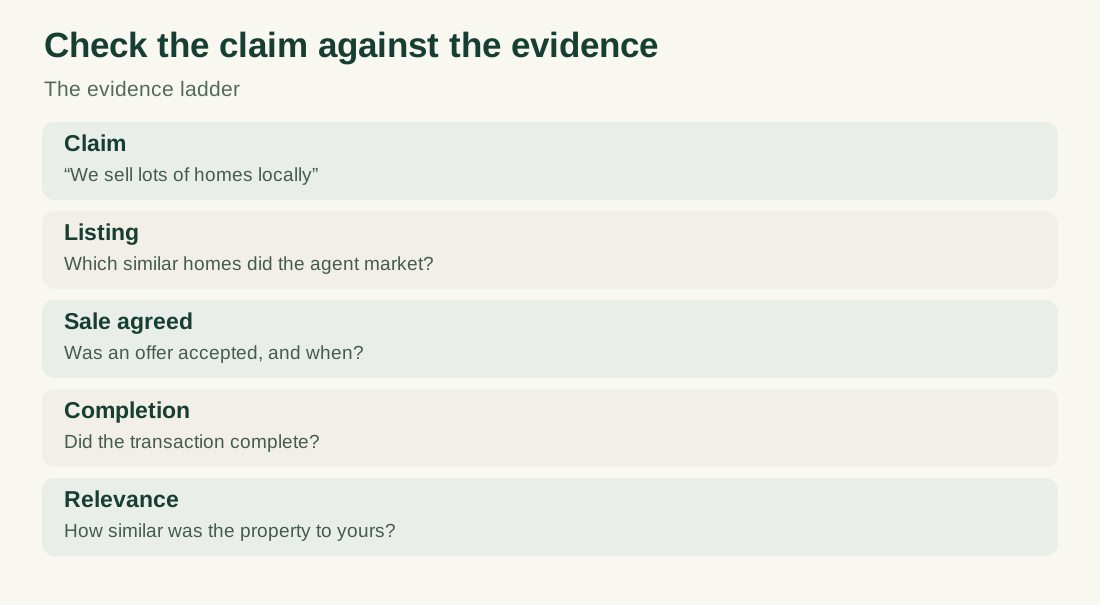
Claim: “We sell lots of homes locally”. Listing: Which similar homes did the agent market?. Sale agreed: Was an offer accepted, and when?. Completion: Did the transaction complete?. Relevance: How similar was the property to yours?.
Be careful with percentages and small samples
You may be shown an asking-price-to-sale-price percentage, average time to find a buyer or a proportion of listings sold. Such measures can be informative only if you know what went into them.
Ask for the period covered, number of properties, property types and definition of each measure. Does 'sold' mean an offer accepted or a completed transaction? Does the time calculation begin at the first listing or at the latest relaunch? Are withdrawn homes included?
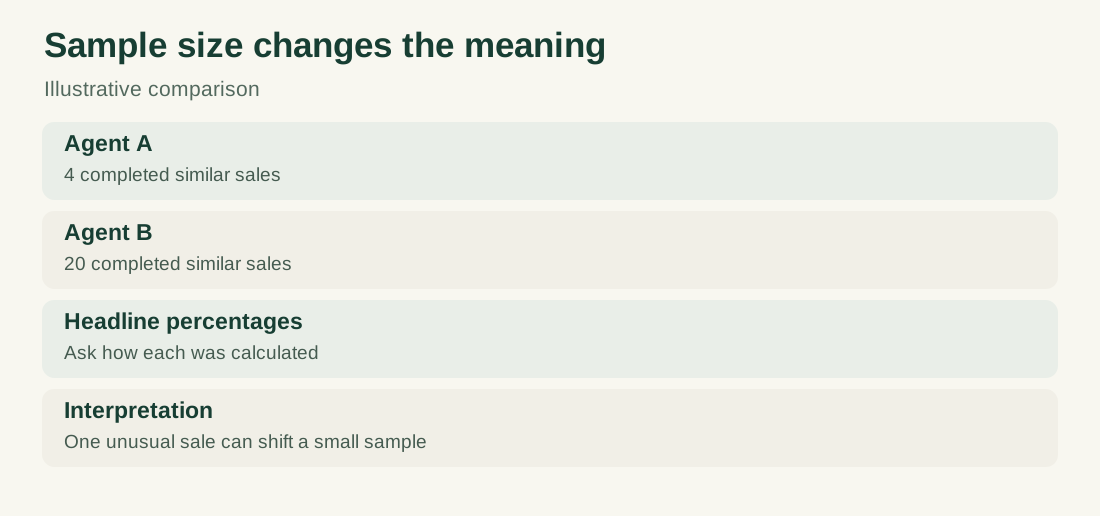
Illustrative example. One agent completes four similar transactions and another completes twenty. The first reports a higher percentage of asking price achieved. That may reflect excellent work, but with only four transactions, one unusual sale could have a large effect. It would be unwise to treat the percentage alone as decisive.
Also remember that asking prices are chosen by sellers and agents. Achieving a high percentage of an initially cautious asking price is not the same as achieving a higher absolute sale price.
 Illustrative example
Agent A: 4 completed similar sales. Agent B: 20 completed similar sales. Headline percentages: Ask how each was calculated. Interpretation: One unusual sale can shift a small sample.
Separate the agent's record from the wider market
If every comparable property has taken longer to sell, a slower transaction may say more about local demand than about the agent. Conversely, a busy market can make an ordinary record look impressive.
Compare outcomes with similar homes in the same period where possible. Look at the quality of the original marketing, subsequent price changes and whether the property eventually completed. Do not rely on a single success story.
For a method of checking the underlying transactions, see how to use sold house prices.
Ask what happened when a sale became difficult
The most useful evidence may be an agent's explanation of a challenging instruction. Ask how they handled a buyer withdrawing, a survey problem or a property that attracted little interest. They can describe their process without disclosing confidential client information.
Listen for practical detail. Did they change the photography, reassess the comparable evidence, qualify a replacement buyer or alter their viewing arrangements? An agent who can explain decisions and trade-offs is giving you something more substantial than a claim of local dominance.
You can also ask who personally handled the sale. A firm's history is not necessarily the history of the negotiator who will manage your property.
Put the evidence beside the service
A credible track record is one reason to consider an agent, not the whole decision. Their current team, marketing standards, communication and contract terms still matter.
Use the estate agent comparison guide to assess the wider service, and the guide to fees and inclusions to examine what you would pay.
PMD can help you examine the comparable sales and pricing evidence for your own home through a Property Intelligence Report. It does not provide a ranking of local agents. PMD is a trading name and service of The Ivybridge Collection Ltd, whose registered nature of business is real estate agencies, and we also sell marketing subscriptions to estate agents. Its perspective should not be presented as wholly detached from the agency market.
Before choosing, ask the agent to identify three genuinely comparable instructions, explain what happened to each and show which parts of that experience are relevant to your home. That is a far more revealing conversation than asking how many boards they have in the area.
Sources
- HM Land Registry, About the Price Paid Data: Describes recorded completed property transactions and data coverage