
Selling your home
Should you reassess your home’s value after a sale falls through?
A failed sale does not automatically mean the house was overpriced. First establish why the transaction stopped, then assess whether the property, market evidence or buyer position has changed. The earlier agreed price remains information, but it is not a completed sale.
This is an estimate from comparable sales, not a RICS or mortgage valuation, and not a survey.
Find the reason the agreement failed
Ask the agent to separate what is known from what is inferred. A chain problem, a buyer's funding issue and an unresolved property concern may lead to different next steps. “The buyer pulled out” is an event, not a complete diagnosis.
Record the timing and available explanation. If a survey or lender assessment raised a question, obtain the appropriate information rather than repeat an informal description as a confirmed finding.
The government's selling guidance explains the stages and professional roles in a property transaction. Use those distinctions when assessing the failure. An offer agreement and legal completion should not be described as the same evidence.
What does the agreed price tell you?
It shows that a particular buyer was willing to agree a figure at a particular point, subject to the transaction's circumstances. It does not establish a completed-market benchmark or the next buyer's position.
Keep the evidence that supported the agreement beside the reasons it failed. Ask whether a new assessment needs to address a property fact, a market change or simply the availability of another buyer.
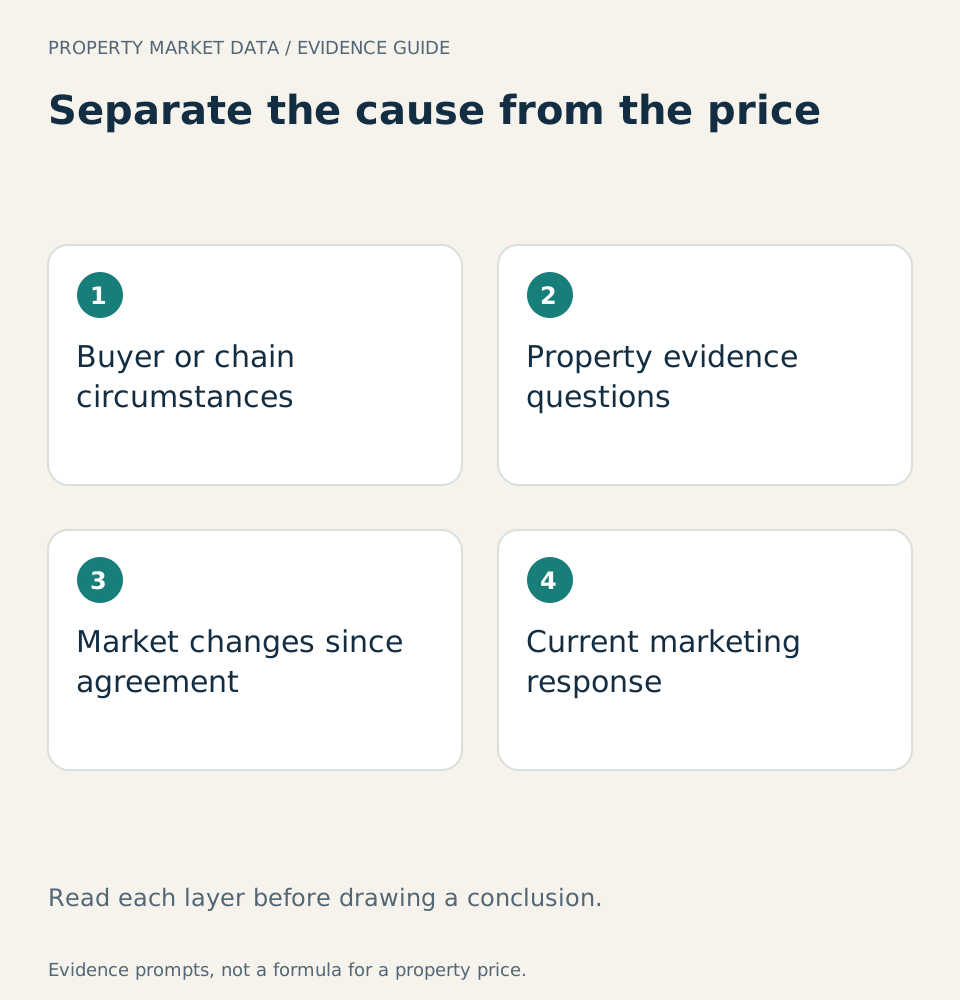
Buyer or chain circumstances; Property evidence questions; Market changes since agreement; Current marketing response. Read the evidence together before making a property-specific judgement.
Deciding whether to accept an offer addresses the separate question of evaluating a current proposal. Do not assume a replacement buyer should offer exactly the same amount merely because an earlier agreement existed.
Check changes since the agreement
List any material property developments and fresh market evidence. Record the actual dates. A change in your moving timetable may affect your priorities without changing the property's market evidence.
When an older valuation needs checking again helps identify whether a previous assessment remains useful. Ask for an explanation of what needs updating rather than purchase a new number without a defined question.
Choose the response that addresses the cause
If the failure concerned a buyer or chain, the next focus may be qualification and transaction readiness. If a property question remains, appropriate investigation may be required before relaunch or negotiation.
If the market evidence no longer supports the earlier strategy, review the price with a reasoned explanation. Avoid an automatic reduction merely because the previous sale did not complete.
Record why the transaction stopped
| Check | What to establish |
|---|---|
| Buyer funding | Distinguish a lender issue from a change in buyer circumstances. |
| Survey information | Identify any property question supported by a report. |
| Legal issue | Ask the conveyancer what remains unresolved. |
| Chain event | Separate another transaction problem from evidence about your home. |
Do not translate every failed sale into a pricing mistake. Equally, do not ignore a supported concern merely because the buyer has withdrawn. Review the reason with the relevant adviser, then decide whether the property information, marketing explanation or asking strategy needs changing. Keeping that sequence clear helps you make a focused response.
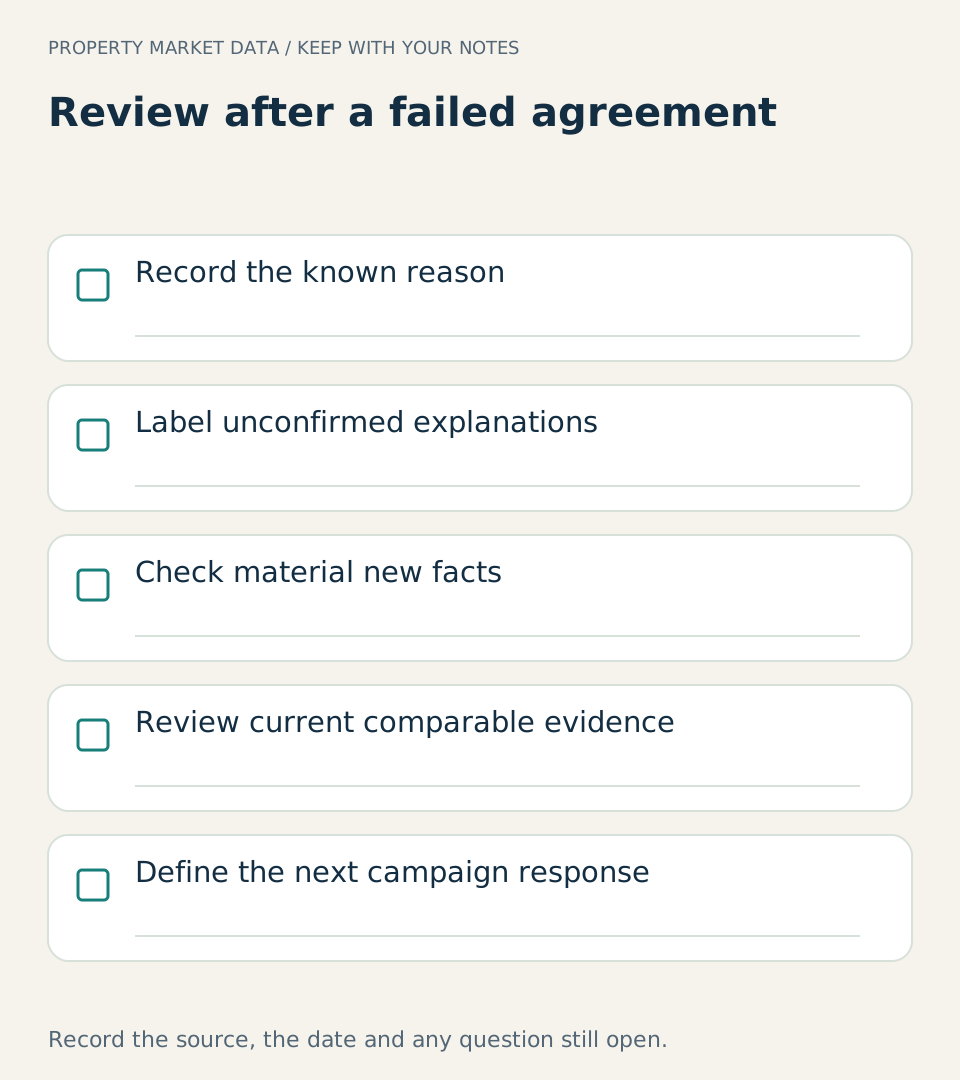
Record the known reason; Label unconfirmed explanations; Check material new facts; Review current comparable evidence; Define the next campaign response. Record the supporting document and any unanswered question.
Relaunch only with a clear account of the change
Relaunching an unsold property considers the marketing plan. A failed sale may prompt a new campaign, but the campaign should reflect the actual issue rather than rely on a different headline alone.
Keep the listing accurate and discuss material information with the appropriate professionals. A marketing refresh is not a way to remove a documented property concern from the transaction.
Ask the agent what will be different and how you will evaluate the response. That makes the next stage a reasoned plan rather than a reaction to disappointment.
Use PMD to review the evidence question
A PMD report can organise current comparable sales and local context for an eligible home. Use it to examine whether the old agreed price still has relevant support, not as proof that the earlier buyer should have completed.
Read the sample and explanation before deciding what additional information you need. A human review is a written property market opinion on your own report, within the stated service scope.
Keep buyer, property and market issues distinct in your decision record. The next step should answer the reason for the failure and the evidence now available, not simply reproduce or abandon the earlier figure.
Sources
- Government guidance, How to sell a home: Estate agent appraisals, selling preparation and checking service scope
- HM Land Registry, Price Paid Data: Recorded transaction evidence and broad property-type categories
- MoneyHelper, Mortgage fees and moving costs: Lender valuation purpose and separate moving-cost categories