
Formal property valuations
Why is a rebuild cost assessment different from your home’s market value?
The price a home might sell for and the cost of reconstructing it are different assessments. Do not use an online sale estimate as the insurance figure simply because both concern the same building. Ask what the policy and the reconstruction assessment require.
This is an estimate from comparable sales, not a RICS or mortgage valuation, and not a survey.
Identify which number the question needs
Market value concerns the property in a market transaction. An insurance reinstatement assessment concerns reconstruction following the event and on the basis specified. The professional guidance on reinstatement costs explicitly distinguishes that purpose from market valuation.
A home can have features that affect buyer demand and features that affect reconstruction in different ways. The two figures should not be assumed to rise and fall together or to match.
Start by asking the insurer what information is needed. Then identify whether a professional assessment is appropriate for the building and purpose. An estate agent's asking-price suggestion answers a different question.
Reconstruction involves a defined scope
Ask the professional what the assessment includes and the basis it uses. The building, access, relevant materials and other site-specific factors can need attention. The report should explain its own assumptions rather than leave you to infer them from the final figure.
This guide does not calculate a sum insured. Do not create one by applying an unexplained percentage to a sale estimate, a land value or an owner's renovation budget.
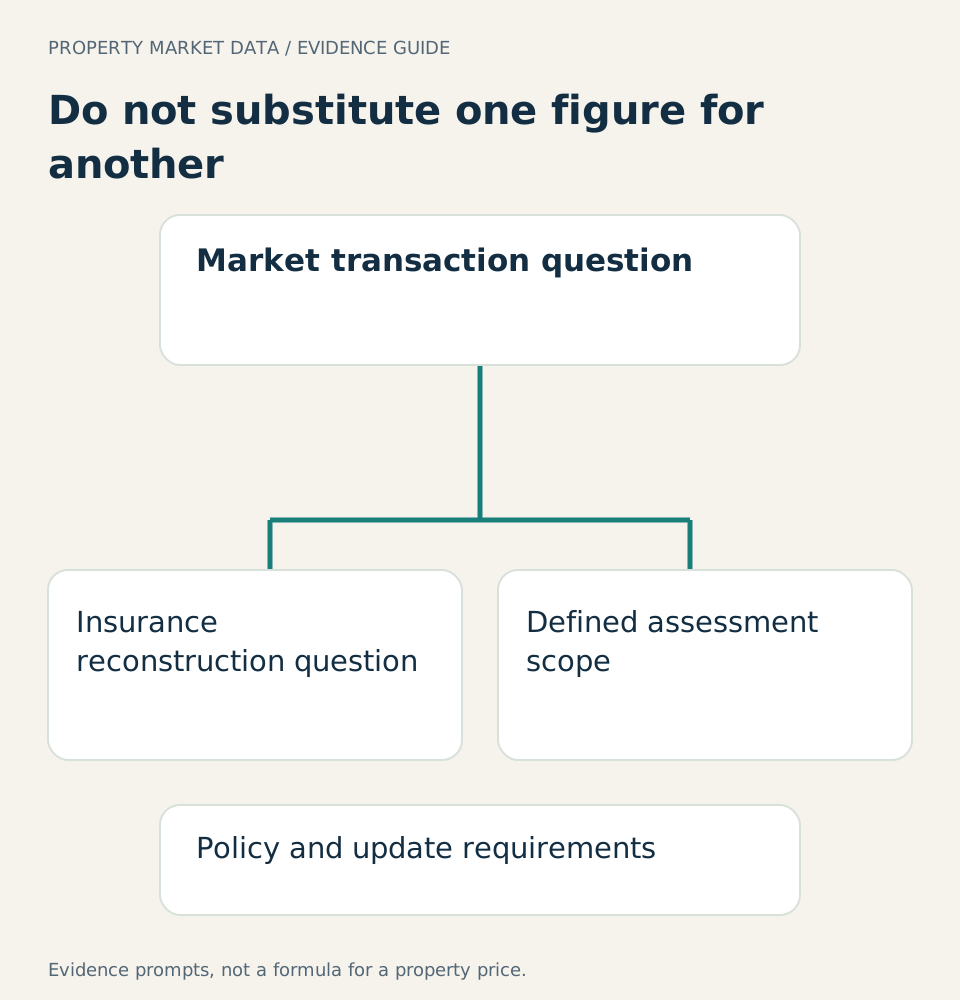
Market transaction question; Insurance reconstruction question; Defined assessment scope; Policy and update requirements. Read the evidence together before making a property-specific judgement.
Asking price, market value and sale price explains other property figures that are often confused. A recorded completed transaction still does not become a reconstruction assessment simply because it is a factual price.
Unusual buildings need suitable questions
For a historic home, assessing listed-building evidence explains why actual fabric and documents matter. Give the insurer and assessing professional the relevant information rather than assume a standard calculation suits every building.
If flooding is material, flood-risk evidence concerns another set of questions. A market comparison, insurance terms and a reconstruction figure remain distinct even when the same risk is being discussed.
Keep policy terms and property facts together
Our suggested record has the policy question, the relevant building description and the source of the assessment. Ask how updates should be handled and which changes need to be reported.
Do not rely on a previous owner's figure without checking its basis and current suitability. Equally, a new sales valuation does not by itself establish that the insurance assessment should change to the same amount.
Keep the insurance question distinct
| Check | What to establish |
|---|---|
| Assessment purpose | State that you need reconstruction information for insurance. |
| Building details | Provide construction, size and unusual features. |
| Scope | Ask what demolition, professional work and other elements are considered. |
| Policy use | Check how the insurer expects the assessment to be supplied. |
A desirable location can influence sale value without changing the physical reconstruction task in the same way. A complicated building can also create reconstruction questions which a residential sale comparison does not answer. Review the insurance information with the appropriate adviser. Do not replace an established insurance assessment with a market estimate simply because the latter is easier to obtain.
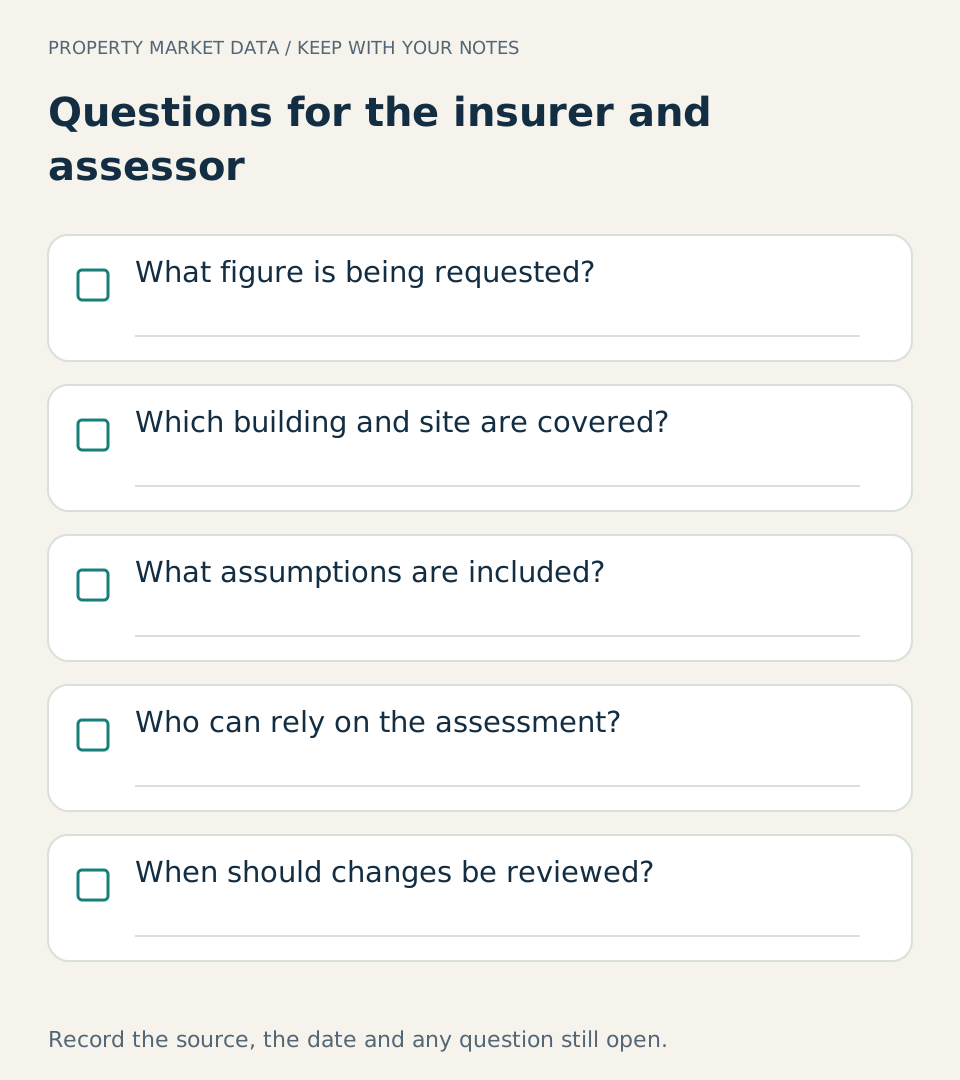
What figure is being requested?; Which building and site are covered?; What assumptions are included?; Who can rely on the assessment?; When should changes be reviewed? Record the supporting document and any unanswered question.
Ask for explanation instead of a shortcut
Before commissioning work, ask who prepares the assessment, what property it covers and who can use it. Confirm the purpose and any limitations. A generic house valuation label is not enough to establish that.
If the report or insurance request is unclear, seek clarification through the appropriate provider. An attractive price for an unrelated report does not resolve the insurance question.
A clear briefing prevents the same number being copied between documents with different meanings. Keep the formal assessment identified by its actual purpose.
PMD does not supply insurance reinstatement assessments
PMD's automated report uses comparable and local-market evidence to support a sale or purchase enquiry. It should not be used to set reconstruction cover or represented as an insurance valuation.
For that task, use the insurer's instructions and appropriate professional advice. If you separately need to understand the sale market for an eligible home, PMD can organise research for that different purpose. Read the scope limits.
The same home can legitimately have several different assessed figures. Understanding what each figure is for is more useful than trying to make them agree.
Sources
- Royal Institution of Chartered Surveyors, Reinstatement assessment factors: Insurance reconstruction assessment differs from market value
- Historic England, Thinking of buying an older building: Condition, specialist advice and information needs for historic buildings; England
- Royal Institution of Chartered Surveyors, Flooding consumer guide: Flood history, risk information, insurance and property-specific assessment