
Specialist property valuations
How should flood risk be considered when assessing a home’s value?
Flood risk deserves a property-specific investigation. A map, a history of flooding and an insurer's response answer different questions. Bring those facts together before deciding how the issue should affect your price assessment or purchase.
This is an estimate from comparable sales, not a RICS or mortgage valuation, and not a survey.
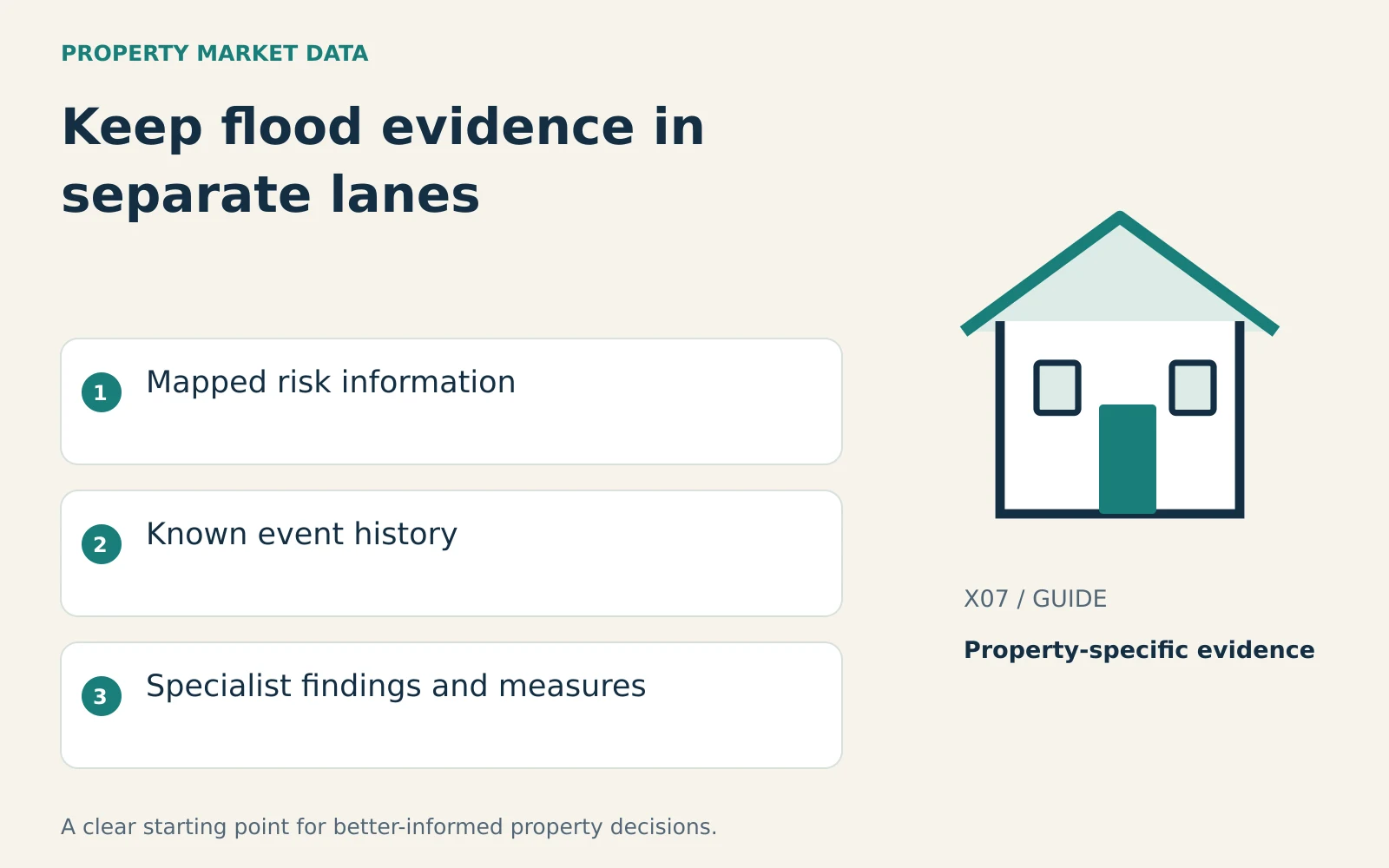
A risk map is a starting point
The professional consumer guide to flooding distinguishes general area information from detailed assessment of an individual property. It also identifies different sources of flooding. Do not treat a reassuring result for one source as proof that every source has been checked.
Use the relevant official flood-information service for the property's location. Record what the search covers and any limits stated. In England and Wales, the relevant national services differ, so start with the correct geography.
This is research preparation, not a certificate of safety. If the issue is material, a suitable specialist should advise on the particular building and site.
Separate history from future risk
Ask about actual events, their source and available records. No known previous flood is not the same statement as no future risk. Equally, evidence of a past event needs to be understood rather than converted into an assumed permanent discount.
Collect records of repairs, resilience measures and any professional assessments. Ask what the measures address and what remains uncertain. The existence of a barrier does not establish that all relevant risks have been resolved.
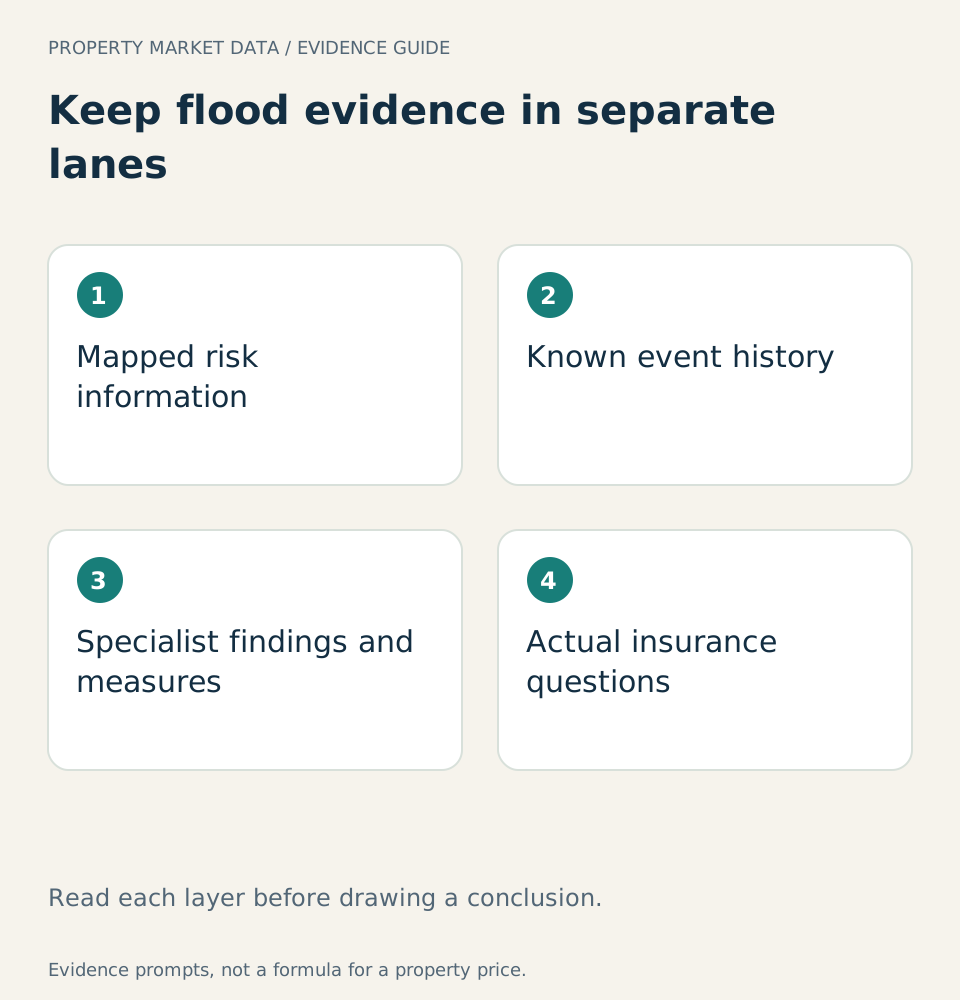
Mapped risk information; Known event history; Specialist findings and measures; Actual insurance questions. Read the evidence together before making a property-specific judgement.
For a buyer, checks before making an offer helps organise information requests. Give important flood questions to the conveyancer, surveyor and insurer rather than relying only on the listing description.
Establish the insurance position
Ask an insurer about the actual property and intended policy. A previous owner's account of their cover does not establish the terms available to a new buyer. Keep the response with the other evidence.
Do not use the estimated sale value as the basis for an insurance reconstruction figure. Rebuild cost and market value explains why those are different assessments.
How should the price discussion use this information?
Professional flood guidance recognises that the effect on value can vary with the property's circumstances. That is not a basis for applying a universal percentage to every home with a risk marker.
Ask which completed sales provide relevant evidence and whether their flood circumstances are understood. An apparently similar house with different risk, history or insurance conditions may not support a simple comparison.
Choosing comparable sales explains evidence relevance. Keep the flood facts attached to the comparison rather than treating the environmental question as a footnote.
Keep different flood questions separate
| Check | What to establish |
|---|---|
| Mapped risk | Record the source, location and type of risk being shown. |
| Past event | Ask what happened to this property and what records support it. |
| Resilience work | Establish the work completed and supporting documentation. |
| Insurance | Get property-specific terms rather than relying on a neighbour's experience. |
An absence of known flooding is not the same as an absence of future risk. A previous event also needs context: extent, repairs and subsequent evidence matter. Keep those facts separate in your notes. When comparing sales, ask whether the comparison properties share relevant exposure rather than applying a general adjustment across the whole area.
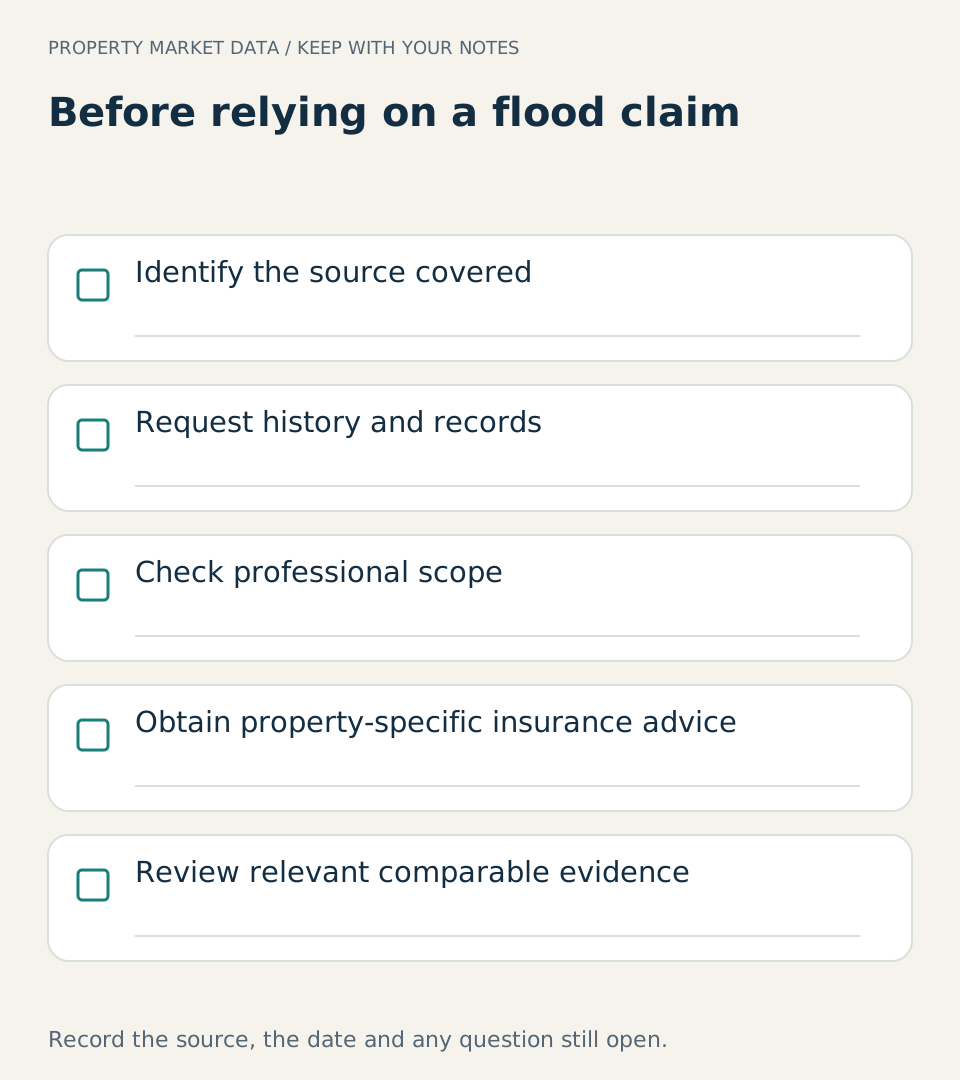
Identify the source covered; Request history and records; Check professional scope; Obtain property-specific insurance advice; Review relevant comparable evidence. Record the supporting document and any unanswered question.
Decide what remains to be established
Our suggested record separates mapped information, seller answers, specialist findings and insurer information. Write down which question each item answers. This helps reveal when several documents repeat the same limited point.
If an important answer is missing, investigate it before treating the price as settled. A lower asking price does not by itself compensate for an unknown risk or make a property suitable for your needs.
Where PMD fits
PMD can provide market and comparable-sale context for eligible homes. It does not perform a flood inspection, determine insurance terms or establish an environmental adjustment for every property. Read the data explanation and confirm the service is suitable.
Use a report alongside the relevant professional evidence, not instead of it. The useful aim is a price discussion grounded in the actual property's circumstances, with unresolved questions made explicit.
Sources
- Royal Institution of Chartered Surveyors, Flooding consumer guide: Flood history, risk information, insurance and property-specific assessment
- Royal Institution of Chartered Surveyors, Reinstatement assessment factors: Insurance reconstruction assessment differs from market value