
Specialist property valuations
Does listed status make a home worth more or less?
Listed status is information about a building, not a price multiplier. Its effect on a sale decision depends on the home itself, its condition and the work a buyer wants to undertake. Examine those facts before assuming the label increases or reduces value.
This is an estimate from comparable sales, not a RICS or mortgage valuation, and not a survey.
The attractive feature and the responsibility may coexist
A buyer may appreciate a historic building's character while needing advice about maintenance and changes. Neither response establishes a fixed financial adjustment. The assessment should explain the specific home rather than treat listed properties as identical.
Historic England's guidance for people buying older buildings discusses specialist information needs and the distinction between a lender's assessment and investigation of condition. Its guidance applies to England. Establish the equivalent authority and requirements for a home elsewhere in England and Wales.
Write down which characteristics attract you and which questions affect your intended use. That produces a more useful brief than asking whether listing is generally good or bad for prices.
Check changes against documents
Ask for information about significant alterations, relevant permissions and work already carried out. Do not infer that a finished room establishes that every approval was obtained. Give the documents to the appropriate adviser rather than interpreting their legal effect yourself.
If you plan changes, identify them early. A buyer's proposed use may depend on work that requires specialist consideration. Avoid justifying an asking price by assuming that a desired alteration will be permitted.
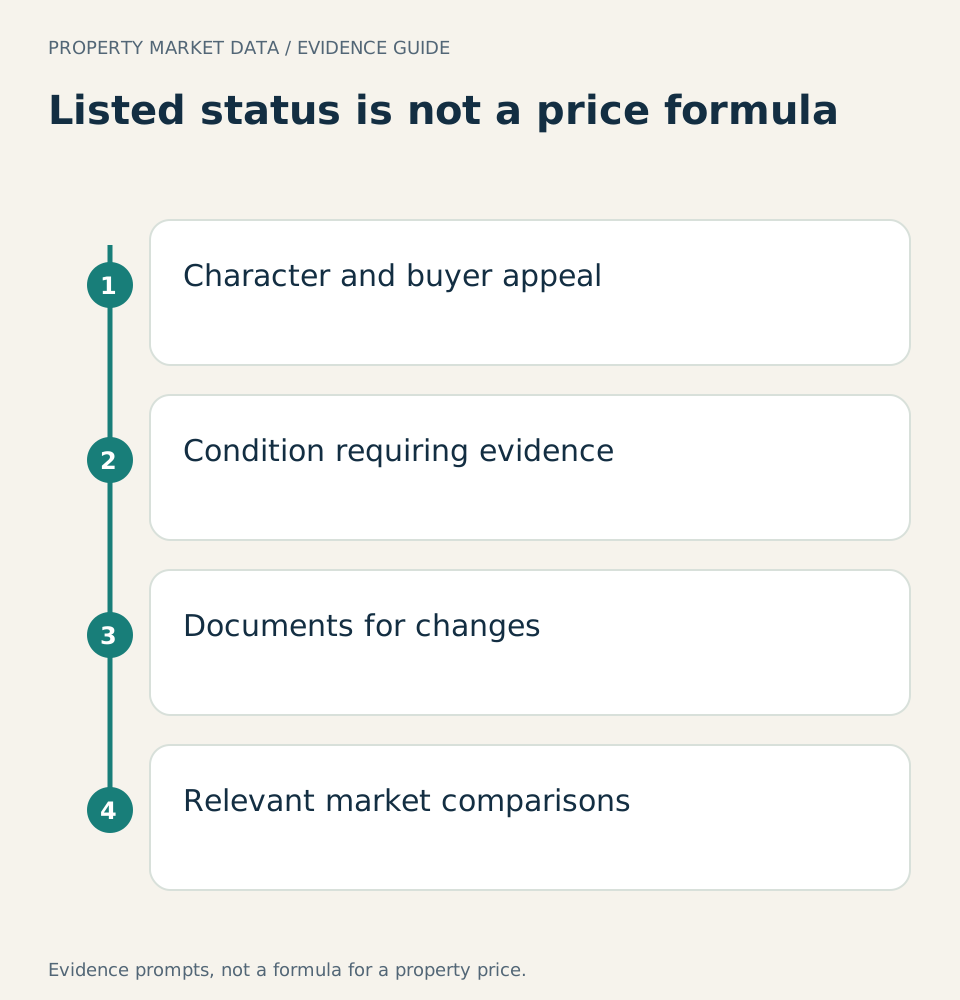
Character and buyer appeal; Condition requiring evidence; Documents for changes; Relevant market comparisons. Read the evidence together before making a property-specific judgement.
Condition belongs in the evidence
Record areas where suitable investigation is needed. Historic materials and previous work may call for relevant experience. A brief viewing and an online estimate cannot determine the condition of all concealed fabric.
How condition affects a property assessment explains why a description of condition should not be substituted for evidence. Use it to organise questions, not to diagnose a building from photographs.
Compare meaningful historic-property evidence
The nearest sale may be convenient but a poor match. Ask whether its age, character, layout, condition and setting are relevant. A comparison with another historic home also needs an explanation of the differences.
Use the approach to unusual homes when close transactions are scarce. A wider evidence search can provide context without making every selected property equivalent to yours.
Do not add an assumed heritage premium to a price already supported by historic-property transactions. That may count the same characteristic twice. Ask the person proposing the adjustment how the evidence supports it.
Separate attraction from obligations
| Check | What to establish |
|---|---|
| Listing information | Read the actual designation and relevant property records. |
| Alterations | Ask for evidence of the permissions relevant to past work. |
| Condition | Use suitable specialist advice for materials and repair questions. |
| Comparable homes | Look beyond a shared listing label to setting and accommodation. |
Do not treat missing paperwork as proof that work was unauthorised, or assume that an attractive finish confirms consent. It is a question to resolve with the appropriate adviser. The pricing discussion should recognise both buyer appeal and outstanding uncertainty, rather than applying a standard premium or deduction to every listed home.
Ask which unresolved question could change your decision and who is qualified to answer it. That may concern repair, alterations or a legal record. Keep those questions alongside the sale comparisons so that appealing architecture does not hide an assumption which still needs checking.
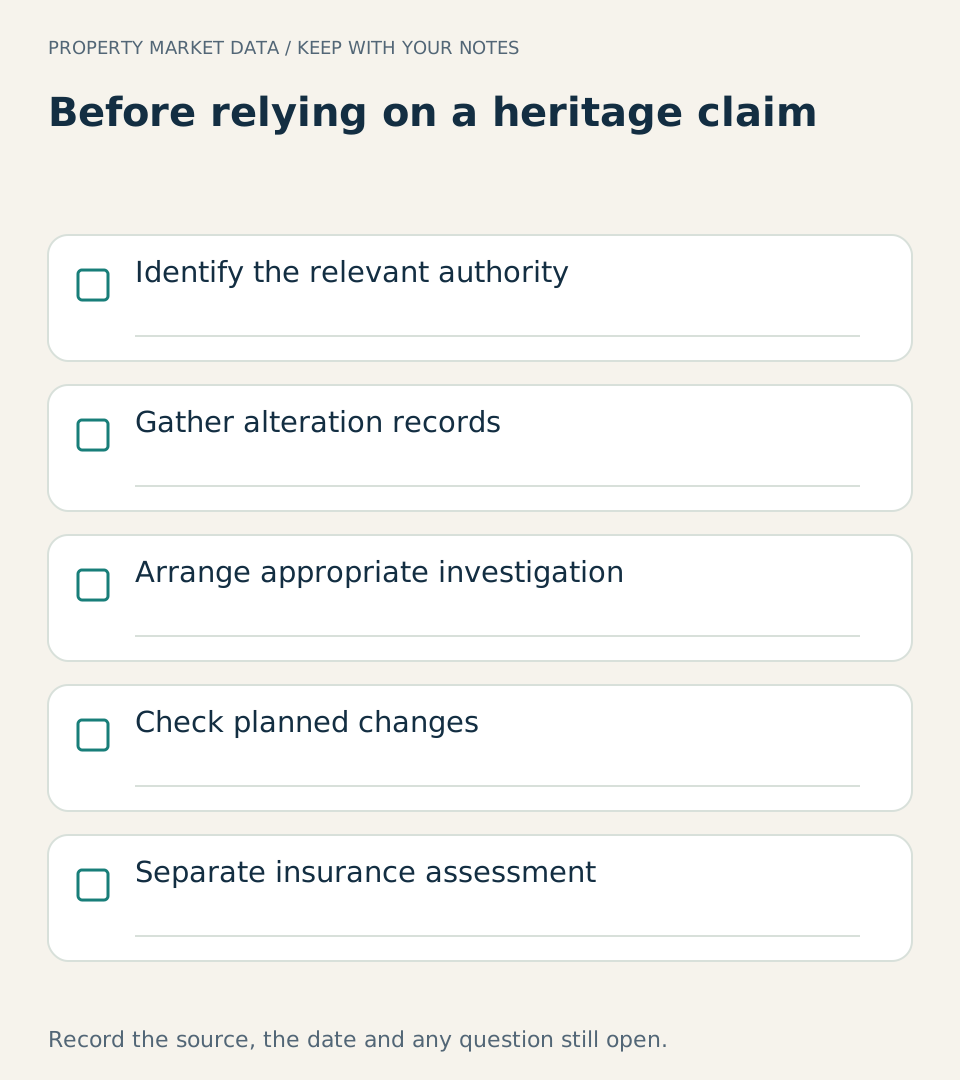
Identify the relevant authority; Gather alteration records; Arrange appropriate investigation; Check planned changes; Separate insurance assessment. Record the supporting document and any unanswered question.
Keep insurance value separate
Sale value and the cost of reconstructing a building are different assessments. Historic construction can make this distinction particularly important. Rebuild cost versus market value explains why a sale estimate should not simply become the amount used for buildings cover.
Ask an insurer or suitable professional what information is required. Do not choose a cover figure from a listing price because both numbers concern the same building.
Use PMD as part of the research
PMD can help assemble available comparable and local-market evidence where the home is supported. It does not confirm consents, inspect historic fabric or provide an insurance reconstruction assessment. Check coverage and the data limits before choosing.
Keep any marketing advice beside the professional findings, rather than replacing them. The valuable question is how the home's documented characteristics and actual condition relate to buyer demand. Listed status begins that enquiry; it does not complete it.
Sources
- Historic England, Thinking of buying an older building: Condition, specialist advice and information needs for historic buildings; England
- Government guidance, Use of planning conditions: Checking actual permission conditions; England planning guidance
- Royal Institution of Chartered Surveyors, Reinstatement assessment factors: Insurance reconstruction assessment differs from market value