
Specialist property valuations
How do parking and garages affect a home’s value?
Parking can matter greatly to a particular buyer, but the advertised label needs checking. A garage, a driveway and a right to use shared space offer different things. Establish what is actually available before deciding how it should influence a price.
This is an estimate from comparable sales, not a RICS or mortgage valuation, and not a survey.
Verify the arrangement described
Ask what is included in the sale and how it is accessed. A space visible beside the house may be owned, allocated, shared or subject to another arrangement. Let the conveyancer establish the legal position when it matters.
For practical use, look at the route and actual space rather than the number of cars suggested in a brochure. Vehicle sizes and manoeuvring needs differ. Check your intended use without assuming that a listing's shorthand covers it.
The government's dropped-kerb guidance points people to the local authority for the relevant application route. The ability to stand a vehicle on a front area does not by itself settle questions about lawful access across the pavement.
A garage is not automatically equivalent to a living room
Record what the building is used for and what it can accommodate. Storage, vehicle parking and converted accommodation are different uses. If the description includes a conversion, ask which plans and approvals describe it.
Checking the floor area in a valuation explains why included spaces need a clear measurement basis. Do not compare garage area with main living accommodation as though the two are necessarily interchangeable.
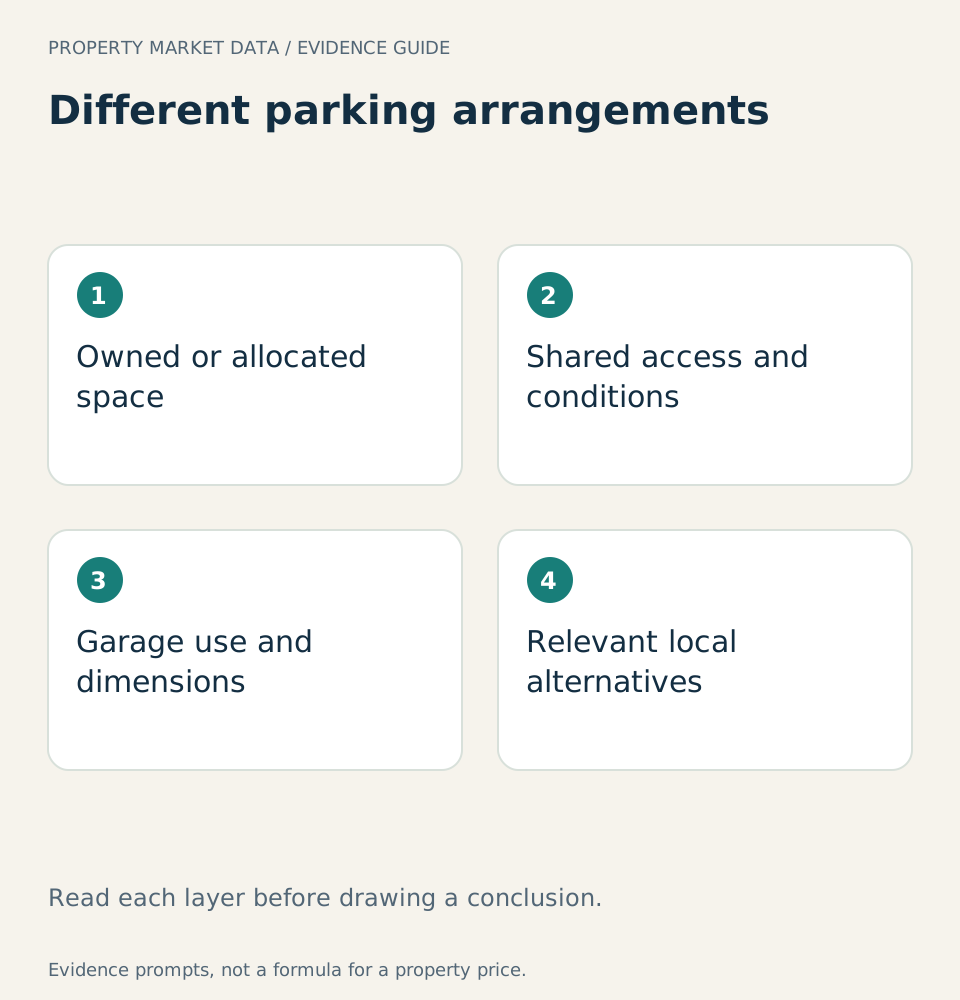
Owned or allocated space; Shared access and conditions; Garage use and dimensions; Relevant local alternatives. Read the evidence together before making a property-specific judgement.
Look at the local alternative
Ask what other parking options exist and what their actual terms are. Our recommendation is to assess the buyer's practical choices, not assume that an area label proves scarcity or a premium.
Keep permissions and availability as questions where they have not been established. A nearby space that looks convenient may not be available to the household buying the property.
Compare property evidence, not standard parking prices
Choosing comparable sales helps identify relevant homes. A comparison is stronger when the parking arrangement is known rather than assumed from an exterior photograph.
If someone proposes a separate value for the garage or driveway, ask whether the comparable sale evidence already reflects that feature. Avoid adding an attraction twice: once through a parking-equipped comparable and again as an extra adjustment.
Garden layout may create a trade-off rather than a simple gain. Garden and plot size considers the outdoor space supporting the home. Keep a change of use or a future project separate from the present arrangement.
Check that parking works in practice
| Check | What to establish |
|---|---|
| Access | Establish the right to use the entrance and relevant crossing arrangements. |
| Dimensions | Consider usable space and manoeuvring rather than a space count alone. |
| Garage use | Describe whether vehicles can actually enter and use it. |
| Local alternatives | Record nearby restrictions and other parking options. |
A paved frontage is not automatically lawful or practical parking. A garage shown on an old plan may now serve another function. Check the property itself and the relevant documents before making either claim. Comparisons should reflect usable access and storage, not simply repeat a listing label which hides important differences between homes.
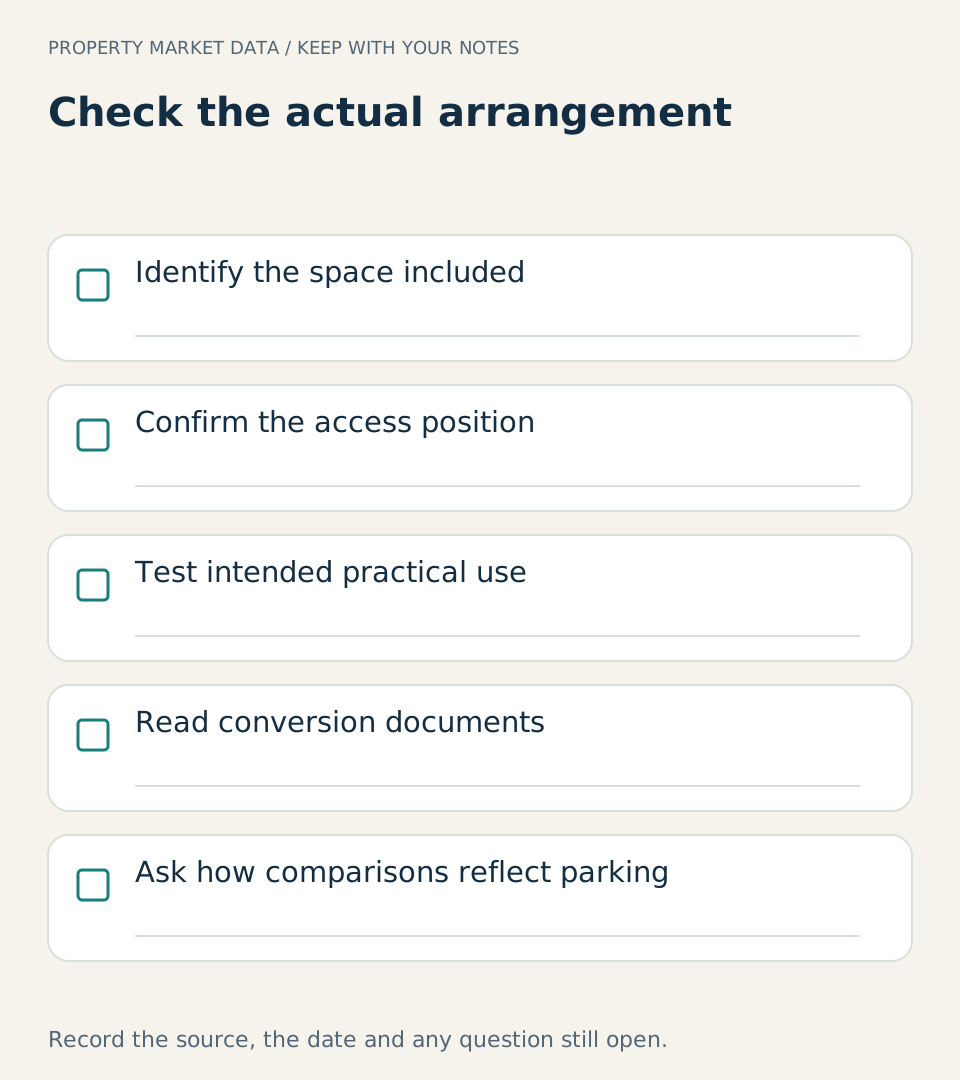
Identify the space included; Confirm the access position; Test intended practical use; Read conversion documents; Ask how comparisons reflect parking. Record the supporting document and any unanswered question.
Make the viewing productive
Check access in the context of normal use and ask about shared routes. For a seller, describe the parking honestly and keep relevant documents ready. A factual explanation can resolve a question that a photograph leaves open.
For a buyer, your own requirements may affect whether the property suits you. That personal preference is important, but it is not evidence of the same premium for every buyer.
Where a right, allocation or permission is unclear, ask the appropriate adviser before relying on it. Price negotiation cannot itself resolve an uncertain legal arrangement.
Where PMD helps
PMD can assemble available comparable transactions and market context. It cannot confirm title, vehicular access rights or the suitability of every parking arrangement. Read the methodology limits and confirm eligibility.
Use the evidence alongside your practical observations and professional answers. An informed assessment describes the actual parking opportunity and its limits rather than attaching an automatic price to the word garage.
Sources
- Government guidance, Apply for a dropped kerb: Local authority route for vehicular access across a pavement
- Government guidance, Your property boundaries: Title plans usually indicate general rather than exact boundaries
- Royal Institution of Chartered Surveyors, Automated valuation models roadmap: Model scope, explainability and evidence limitations