
Specialist property valuations
How can holiday or occupancy restrictions affect a home’s value?
A property can look like an ordinary home while carrying restrictions on occupation or use. Establish the actual wording and get appropriate advice before comparing it with unrestricted houses. What you hope to do with the building is not proof of what is allowed.
This is an estimate from comparable sales, not a RICS or mortgage valuation, and not a survey.
Find the restriction rather than its shorthand
Ask for the relevant permission, agreement, covenant or other document. A listing's phrase “holiday use” or “local occupancy” is a starting point for enquiry, not a complete explanation.
The Lake District National Park's published guidance illustrates that occupancy restrictions can arise through different documents and can have different purposes. That local information does not establish the position for every property elsewhere in England and Wales.
Have an appropriate adviser explain the actual wording and its implications for your proposed use. Keep restrictions on occupation distinct from questions about ownership, letting and the operation of a business.
Compare the intended use with the documented position
Write down how you want to use the property. Then record which document and advice address that intention. If something is uncertain, leave it uncertain until the right person has checked it.
Do not assume that paying a council bill, occupying the property for part of the year or hearing about a previous owner's practice resolves a restriction. These may be facts to discuss, not substitutes for advice about the relevant documents.
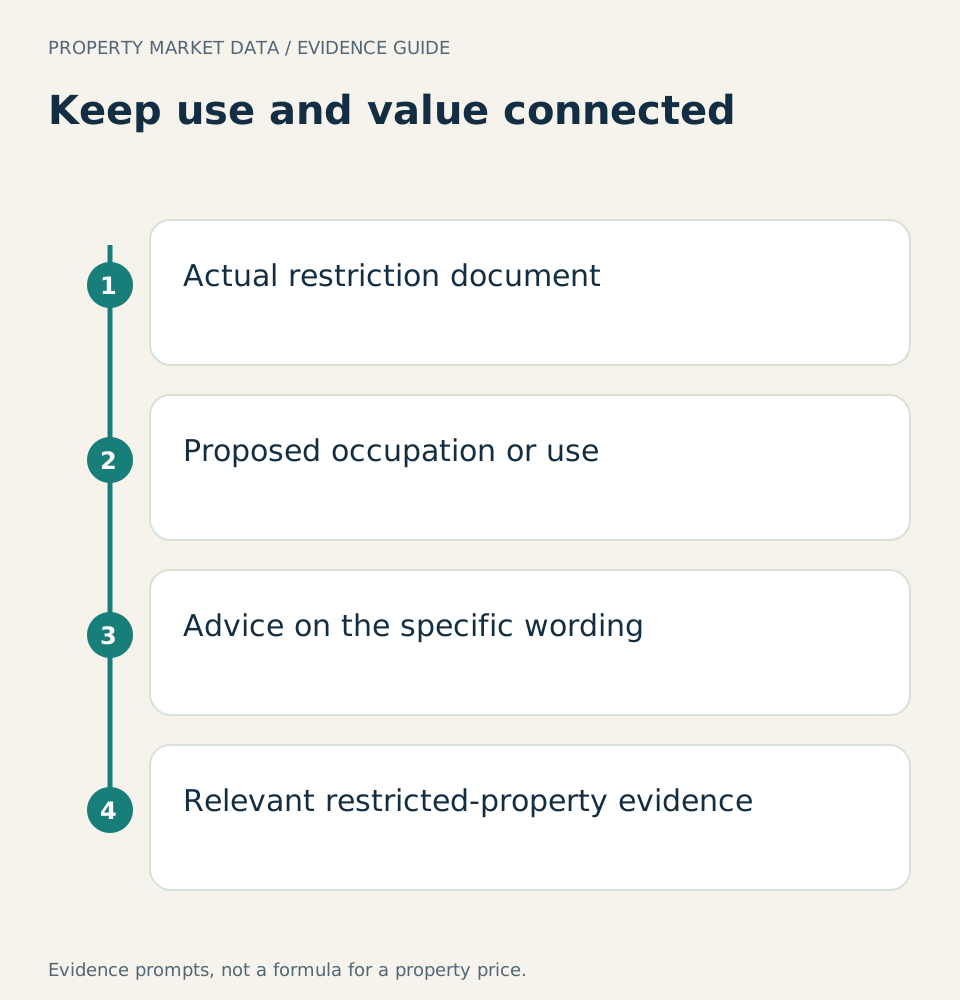
Actual restriction document; Proposed occupation or use; Advice on the specific wording; Relevant restricted-property evidence. Read the evidence together before making a property-specific judgement.
Government planning-condition guidance is relevant context for England, but the conditions applying to a particular home need specific checking. Do not generalise one area's example into a rule for every holiday property.
Distinguish residential value from trading performance
If a holiday-let business is part of the discussion, separate accommodation and rights from income claims. Ask what records support turnover or occupancy statements and what exactly is being sold.
Mixed-use and commercial scope explains why a home estimate should not be treated as a business valuation. A rental-income forecast does not establish permissions or an unrestricted residential value.
Use relevant comparisons
A sale of an unrestricted home may provide context but fail to reflect the same occupation conditions. Ask how the assessor handles that difference and which transactions are genuinely relevant.
Do not apply a standard discount to the unrestricted estimate simply because a condition exists. The effect depends on the actual property, rights and buyer market. A precise adjustment needs evidence and appropriate judgement.
Read the restriction rather than its label
| Check | What to establish |
|---|---|
| Document | Find the actual condition, covenant or lease wording. |
| Permitted occupation | Ask who can occupy and for what purpose. |
| Timing | Check any stated periods through the appropriate adviser. |
| Comparison | Look for properties subject to relevantly similar limitations. |
Terms such as holiday home or local occupancy do not provide a complete legal description. The wording and its source matter. A home marketed to a restricted group may not share the same buyer market as an unrestricted dwelling. Explain that difference without assuming a fixed price reduction or interpreting unclear conditions yourself.
If marketing wording and a legal document appear inconsistent, ask the conveyancer to resolve the difference. A listing description is not authority to occupy the home in a particular way. Keep the explanation with your comparison notes so a later pricing conversation does not quietly assume unrestricted use.
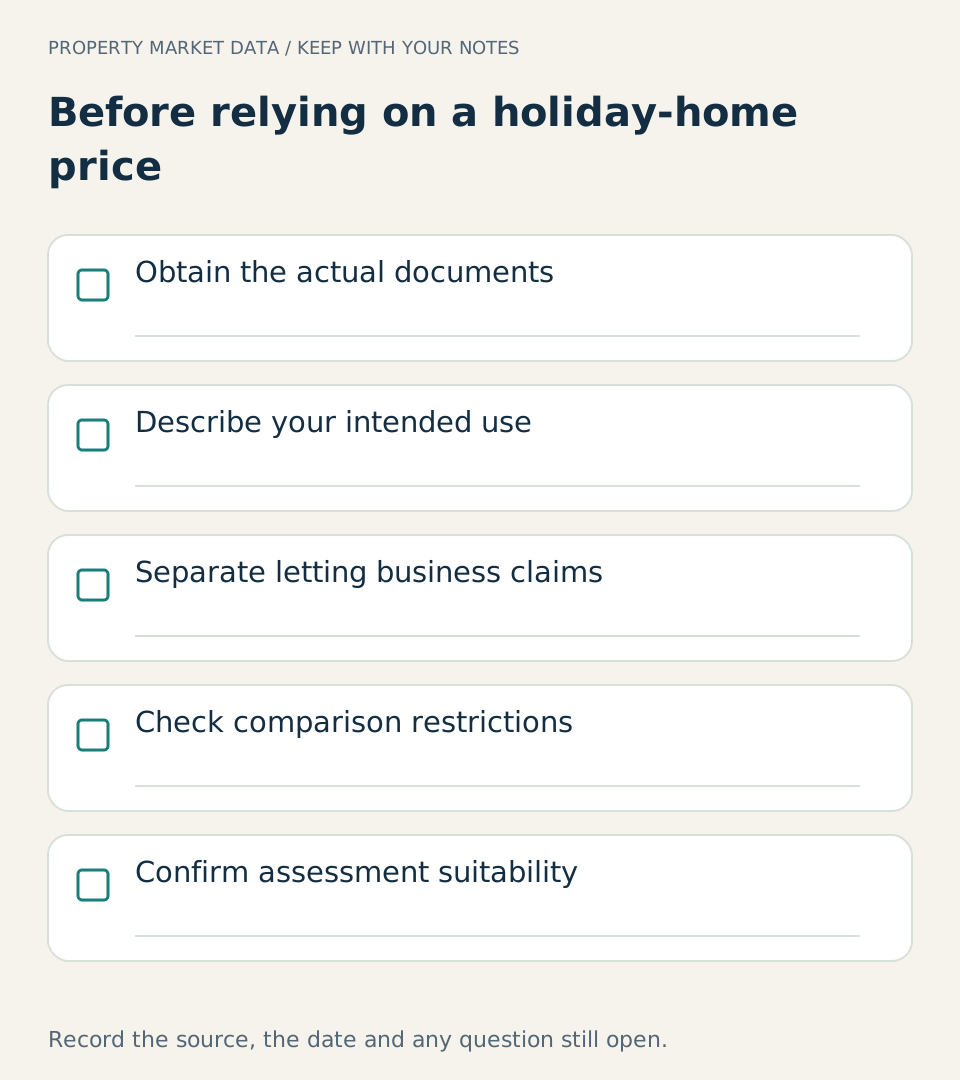
Obtain the actual documents; Describe your intended use; Separate letting business claims; Check comparison restrictions; Confirm assessment suitability. Record the supporting document and any unanswered question.
Prepare before making an offer
Checks before an offer helps organise questions for the agent and your advisers. Resolve material use uncertainties before assuming that a lower asking price makes the home suitable for you.
If a particular organisation needs an assessment, use the guide to valuation types and ask about the required scope. The ability to obtain a number online does not establish that it answers the restricted-property question.
Use PMD for a separate eligible research task
PMD can organise comparable and local-market evidence for eligible homes. It cannot interpret occupation conditions, confirm lawful use or value a holiday-let business. Check the product's suitability rather than assuming every residential-looking building is supported.
For a separate eligible sale decision, read the data explanation and consider the report on that limited basis:
The central task is to understand what the buyer can actually acquire and do. Market evidence becomes useful when it is attached to that documented scope, not an imagined unrestricted home.
Sources
- Lake District National Park, Occupancy restrictions: Examples of occupancy restrictions and their differing legal sources; local illustration
- Government guidance, Use of planning conditions: Checking actual permission conditions; England planning guidance
- Royal Institution of Chartered Surveyors, Red Book: Professional valuation standards and scoped instructions