
Specialist property valuations
How should you assess a home above a shop or with mixed use?
A home above a shop may be a residential purchase, while a building sold with business premises raises a wider instruction. Establish exactly what is included and what needs assessing. A residential estimate should not be assumed to value every commercial element.
This is an estimate from comparable sales, not a RICS or mortgage valuation, and not a survey.
Define the interest being bought or sold
Ask what property, accommodation and rights form part of the transaction. Is the sale a flat, an entire building or a combination of separate interests? Obtain the relevant description and let your legal adviser establish its meaning.
A shared address does not establish shared ownership or identical permitted use. Keep the residential accommodation, commercial space and any business activity on separate lines in your notes.
Professional valuation standards emphasise defined scope. For a mixed-use instruction, explain the actual property and purpose before asking a provider for a price or report.
Daily use matters for the residential comparison
For a flat above a shop, consider access, servicing and the relationship with the premises below. Ask factual questions about the arrangement rather than assuming that every business creates the same experience.
Separate what you observe from what has been confirmed. Opening hours, shared routes and service arrangements may require documentary or professional clarification. A brief visit does not settle every question about the building.
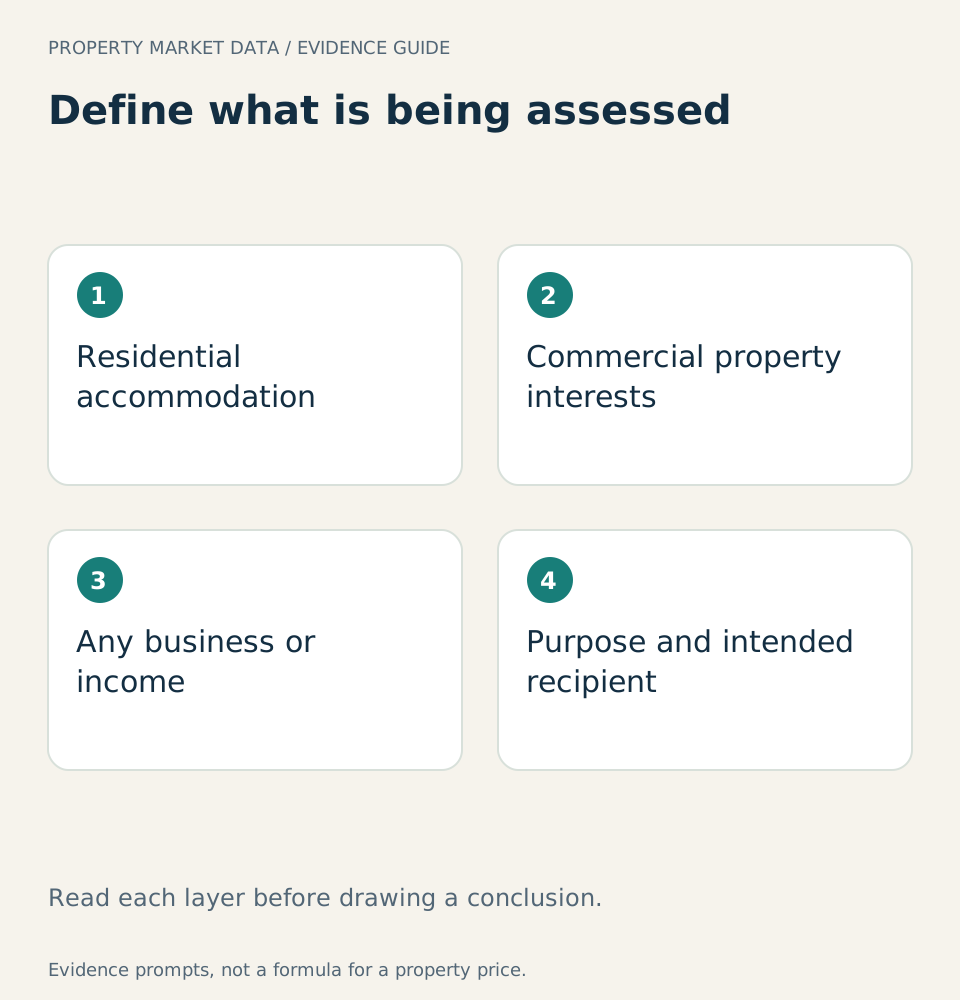
Residential accommodation; Commercial property interests; Any business or income; Purpose and intended recipient. Read the evidence together before making a property-specific judgement.
Commercial income is a different evidence task
If rent, trading income or a business is included in the value discussion, ask precisely what is being assessed. Accounts, lease arrangements and commercial instructions may be relevant. Do not add a headline income multiple to a residential estimate without the appropriate expertise.
Choosing the appropriate valuation type explains the initial purpose check. Equestrian property evidence provides another example where a residential home and a potential business activity should not be collapsed into one assumed figure.
Ask about lending on the actual arrangement
Mortgage valuation purpose explains why your own estimate and a lender's assessment are different. Give the lender or adviser the real property information. Do not assume that a residential report establishes suitability for a mixed-use lending application.
The relevant question is what the lender needs to assess, not whether another website can produce an estimated number for the address.
Define what is being assessed
| Check | What to establish |
|---|---|
| Residential accommodation | Describe the home and its access, layout and setting. |
| Commercial element | Identify any separate business or letting question. |
| Title and use | Ask advisers to establish rights and permitted use. |
| Funding | Explain the mixed use to the intended lender early. |
A combined address does not necessarily mean a single residential assessment answers every question. The premises may involve different users, income arrangements or legal interests. Write down the part of the property and the decision you want assessed. If business income is material, seek an appropriately scoped specialist assessment rather than adding it informally to a home estimate.
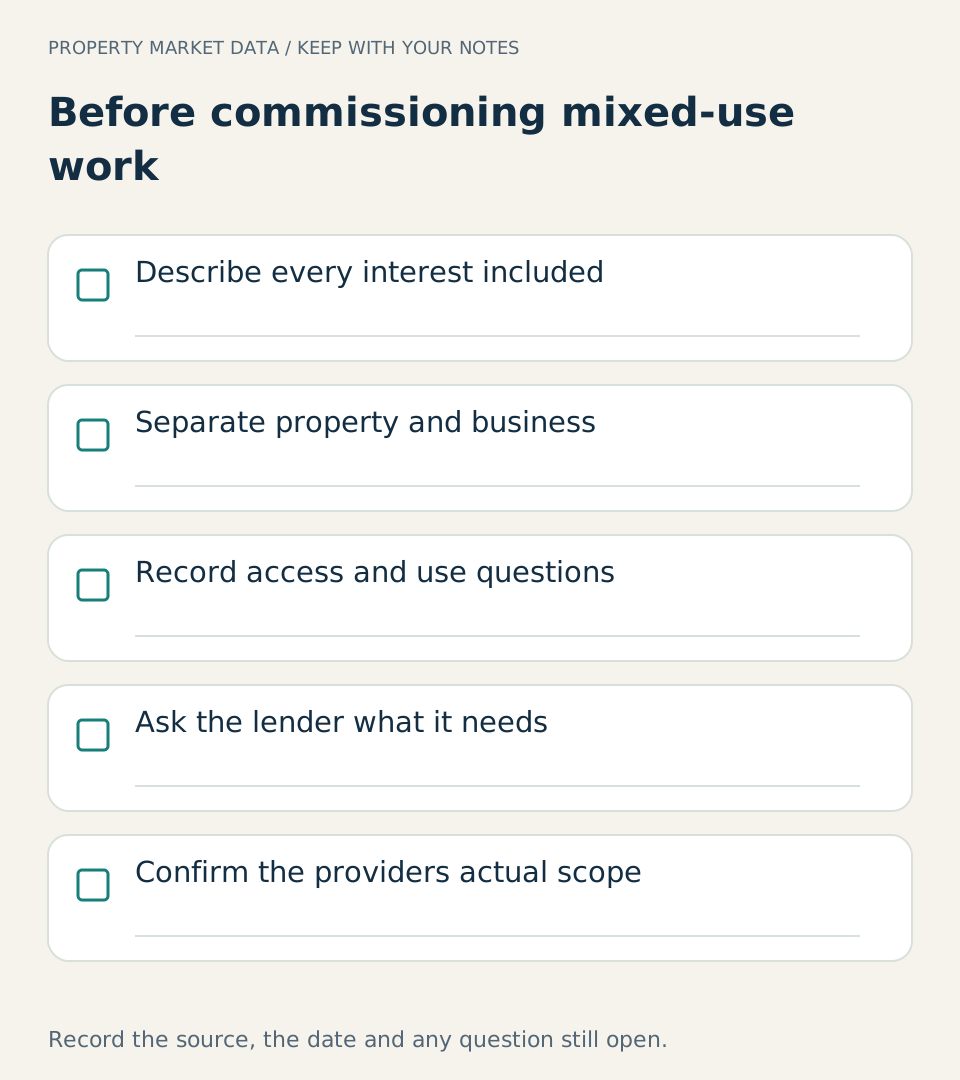
Describe every interest included; Separate property and business; Record access and use questions; Ask the lender what it needs; Confirm the providers actual scope. Record the supporting document and any unanswered question.
Choose comparables with the same question in mind
A residential flat sale may offer useful evidence for the accommodation while leaving other interests unaddressed. A whole mixed-use building sale may introduce different assumptions. Ask the valuer to explain the role of each comparison.
Keep asking price, recorded transaction price and any separate business price distinct. Where information is incomplete, say so rather than combine numbers that describe different assets or interests.
Our suggested briefing note identifies the transaction, the intended recipient of the assessment and any separate income or use question. This helps a professional define the work instead of beginning from an ambiguous label.
Where PMD's scope ends
PMD's automated home report is not a commercial-property or business valuation service. A supported residential enquiry may benefit from comparable and local-market research, but eligibility needs to be confirmed for the actual arrangement.
Read the methodology before ordering. If you separately need evidence for an eligible home sale, start with that clearly defined residential task:
For the commercial interests, business activity or formal mixed-use assessment, commission the appropriate expertise. Keeping the scopes separate makes the evidence clearer and avoids mistaking a partial estimate for a valuation of the whole transaction.
Sources
- Royal Institution of Chartered Surveyors, Red Book: Professional valuation standards and scoped instructions
- Government guidance, Use of planning conditions: Checking actual permission conditions; England planning guidance
- MoneyHelper, Remortgaging: Lender assessment and remortgage process, not personalised lending advice