
Property valuations
Why is there no online estimate for your home?
An unavailable estimate does not mean your home has no value. It may mean a service cannot match the address or does not have enough suitable evidence. Find out which problem you are dealing with before repeatedly trying different forms.
This is an estimate from comparable sales, not a RICS or mortgage valuation, and not a survey.
Separate an address problem from an evidence problem
When a service cannot produce a result, begin with the message it gives you. “Address not found” is different from “insufficient data”. One suggests a matching question; the other suggests a limit in the assessment.
Try to identify the dwelling precisely. A renamed house, recent conversion or divided building can create questions about which address or unit is represented in a provider's records. Do not select the nearest available address just to make a form continue.
Rightmove's online valuation explanation recognises that some properties do not have enough suitable information for a result. An unavailable estimate can therefore be a decision not to display a weak output, rather than a judgement about saleability.
Check the identity before changing the description
Look at the street, postcode, building name and unit information. Keep the same factual details when contacting support. Several attempts using contradictory descriptions can make the issue harder to explain.
If the service displays a record but it is wrong, use the property-detail correction process. If the correct record exists but no estimate is offered, ask whether the restriction concerns coverage, property type or evidence.
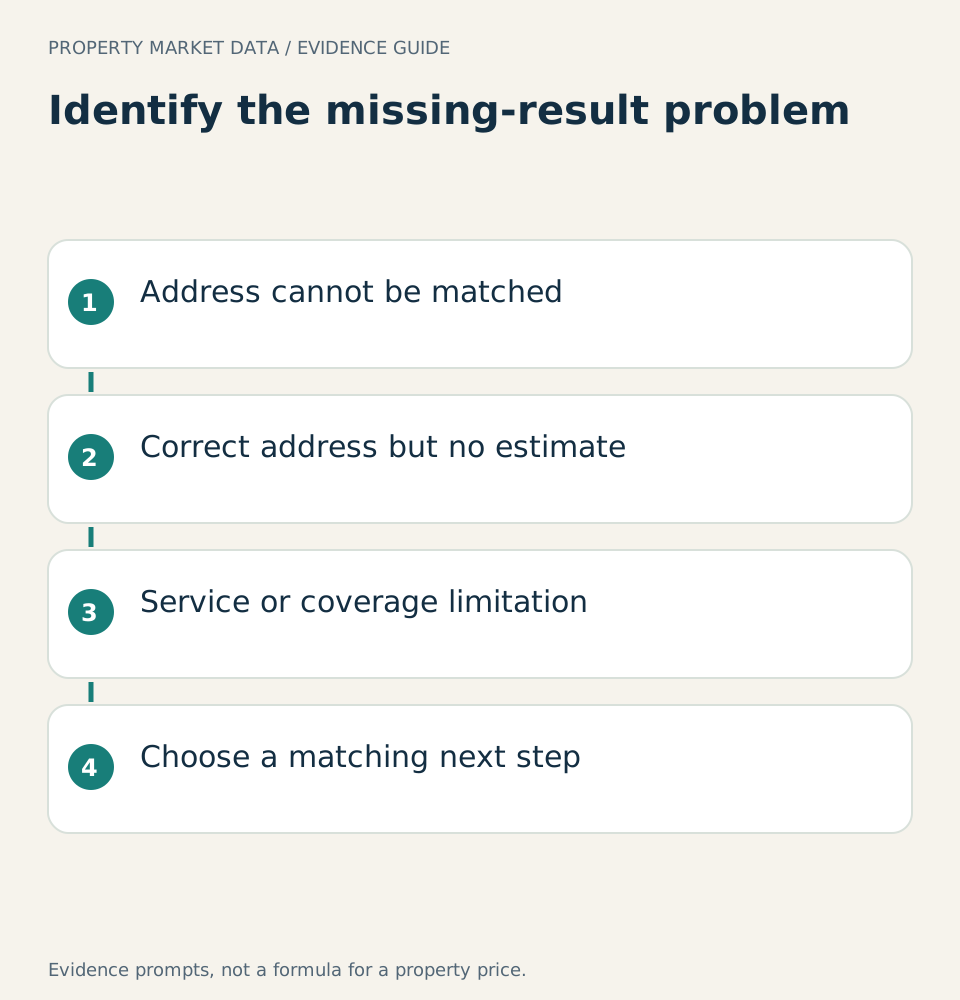
Address cannot be matched; Correct address but no estimate; Service or coverage limitation; Choose a matching next step. Read the evidence together before making a property-specific judgement.
Our recommendation is to record the provider's answer. “Not supported” should prompt a different next step from “temporarily unavailable”. Do not infer that every other service will have the same limitation, but do not treat a second number as proof that the first provider was wrong either.
A sale record is not the whole property
Historic transaction data may establish a sale but leave questions about today's layout or condition. A newly formed dwelling may require information that is not represented clearly in earlier records. Ask what the service needs instead of assuming one document will solve every issue.
Avoid borrowing a neighbour's description. That may produce a figure, but it no longer answers the question about your home.
When the evidence itself is sparse
A lack of close comparable sales is a separate issue from a missing address. Valuing an unusual home with few comparable sales explains that situation. The useful response may involve wider evidence and professional judgement, not another identical automated search.
List what makes the property difficult to match: a distinctive layout, unusual use, a substantial plot or a material change. Then ask an appropriate provider how those features would be assessed and what uncertainty would remain.
Work through the missing result
| Check | What to establish |
|---|---|
| Address mismatch | Try the recognised address, including the correct flat or building number. |
| Recent subdivision | Check whether the specific dwelling has its own recorded identity. |
| Limited comparison | Ask whether evidence is insufficient rather than assuming the home is excluded. |
| Provider scope | Read what types of property the service actually assesses. |
Avoid repeatedly changing the address until a number appears for the wrong home. A result attached to a neighbouring flat is less useful than an honest absence of evidence. If the property is recognised but no estimate is available, take the provider explanation to a professional who can assess the missing information.
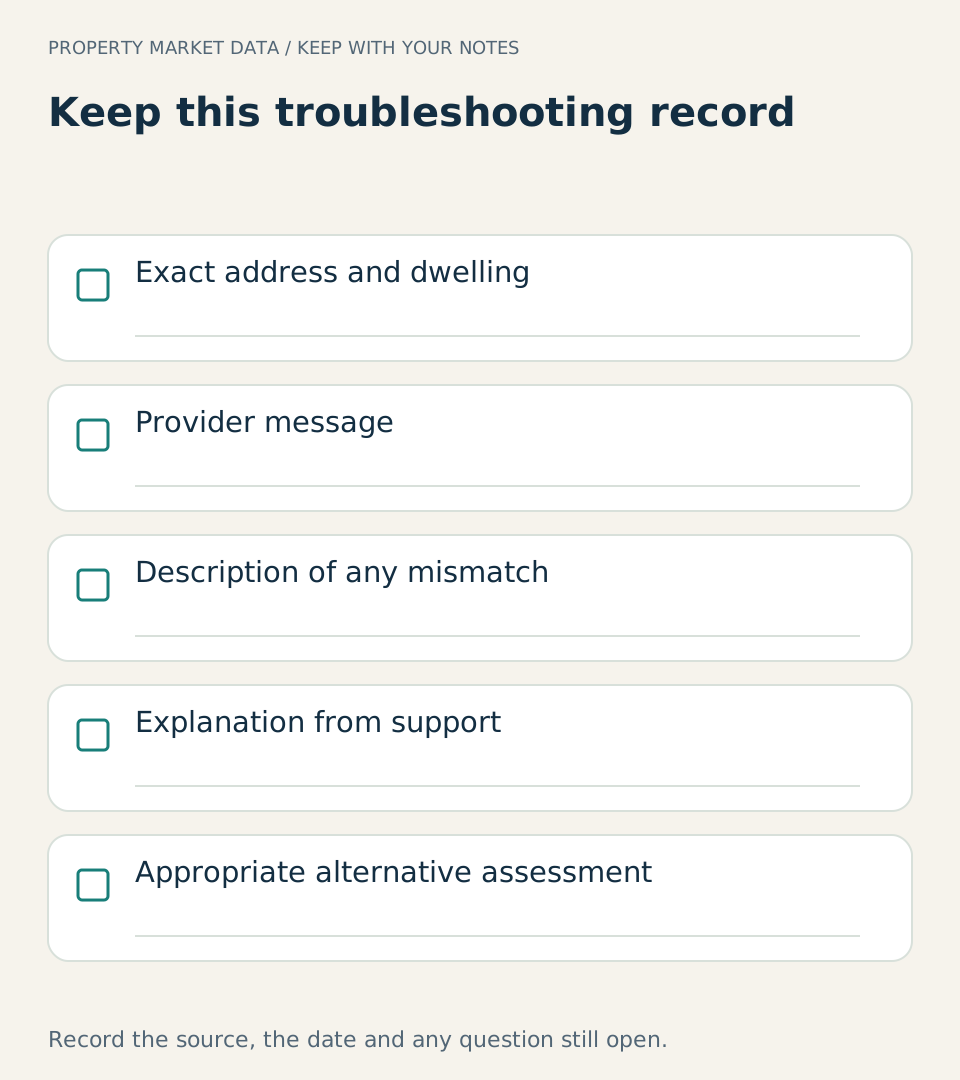
Exact address and dwelling; Provider message; Description of any mismatch; Explanation from support; Appropriate alternative assessment. Record the supporting document and any unanswered question.
If an organisation has requested a particular formal valuation, follow its requirements. An available online number is not a substitute simply because another website refused to calculate one.
Choose a proportionate next step
You might need to correct a record, wait for a service issue to be resolved, provide better information or commission a different assessment. Choose the route that addresses the explanation, rather than retrying until a reassuring price appears.
For practical preparation, read how to research your home before an agent visit. It helps distinguish evidence you can assemble remotely from facts that require observation.
Check PMD's actual coverage
Check PMD's coverage and read how its data is explained before assuming that your home is supported. A report should be selected because its scope fits the decision and the evidence is usable.
If PMD or another service cannot produce a suitable result, keep that limitation visible. The goal is to find an assessment that addresses your property, not to obtain a number at any cost.
Sources
- Rightmove, How online valuations work: Data-based estimates, comparable evidence and limits of remote assessment
- Royal Institution of Chartered Surveyors, Automated valuation models roadmap: Model scope, explainability and evidence limitations
- Zoopla, Viewing property details: Provider-specific property attributes and update information