
Buying and offers
Is a Leasehold Flat Worth Its Asking Price?
Two flats in the same building can have very different financial implications. The asking price is only part of the decision when a lease, service charges, planned works and mortgage requirements are involved. Here is how to compare the property and identify the documents you need before committing.
This is an estimate from comparable sales, not a RICS or mortgage valuation, and not a survey.
The asking price does not tell you the whole cost of a flat
A leasehold flat can appear cheaper than a similar freehold property while carrying commitments that are not obvious in the listing. Those commitments may affect what buyers are willing to pay, what lenders will accept and what it costs to own the home.
The important question is not whether leasehold is automatically good or bad. It is whether the particular flat's price reflects the rights, obligations and risks attached to its lease.
Start with the lease term
Find out how many years remain on the lease and ask for the relevant documents. Do not rely on a rounded number in an advert when the precise term may matter to a mortgage lender or future buyer.
A shorter lease can affect saleability and the cost or feasibility of extending it. Lease extension rules and rights are legally complex and have been subject to reform. Check the current position with a qualified conveyancer or leasehold specialist rather than relying on an old online calculator.
If an agent says the lease can 'easily be extended', ask who would qualify, what process is proposed and which costs have actually been established.
Examine the charges and what they cover
Ask for the current service charge budget, recent accounts and any known arrears or disputes. Find out what is included: insurance, cleaning, lifts, communal heating, management, reserve funds or other services.
A higher service charge is not automatically worse. A well-maintained building with a lift may cost more to operate than a small conversion. But a low charge can also mean insufficient reserves for major repairs.
Check ground rent terms where applicable and ask your conveyancer to explain their implications, including any lender concerns.
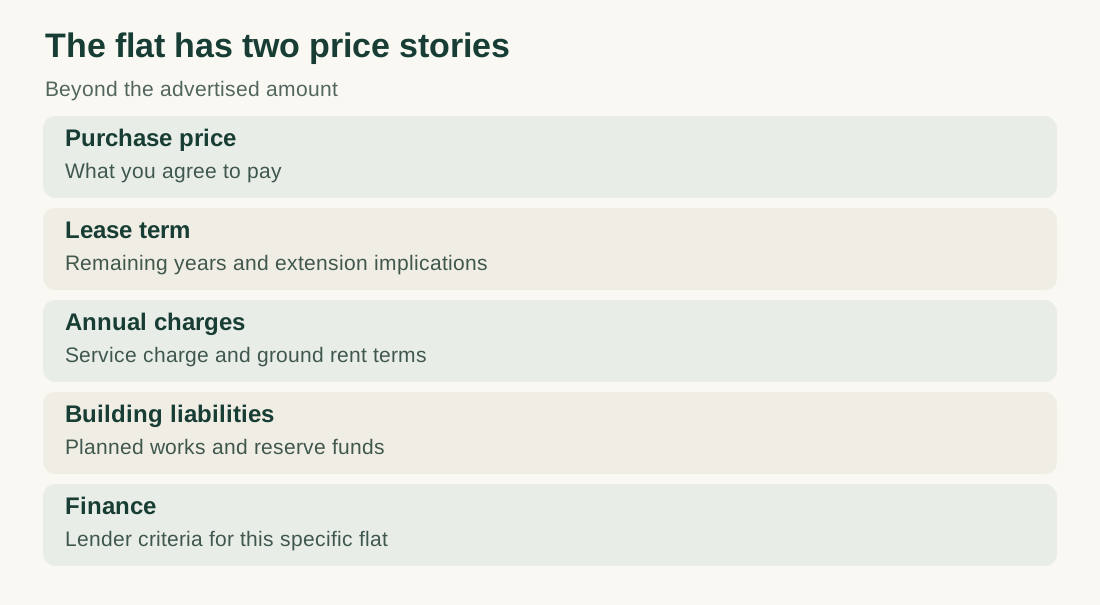
Purchase price: What you agree to pay. Lease term: Remaining years and extension implications. Annual charges: Service charge and ground rent terms. Building liabilities: Planned works and reserve funds. Finance: Lender criteria for this specific flat.
Look for major works, not just routine bills
The financial difference between two flats may lie in planned roof repairs, external wall work, lift replacement or other substantial projects.
Ask whether major works are proposed, whether consultations have begun, what estimates exist and whether a reserve fund is available. For some buildings, building safety documentation and lender requirements will be particularly important.
The seller and managing agent may not know the final cost. An absence of a firm figure is not evidence that there will be no charge.
A surveyor and conveyancer have different roles here. One can assess relevant physical concerns within the survey's scope; the other can investigate lease obligations and documentation.
Compare flats on a consistent basis
Use recent completed sales of flats with similar accommodation, location, building characteristics and, where possible, comparable lease terms. A larger flat with a much shorter lease may not be a better purchase simply because its asking price per square foot looks lower.
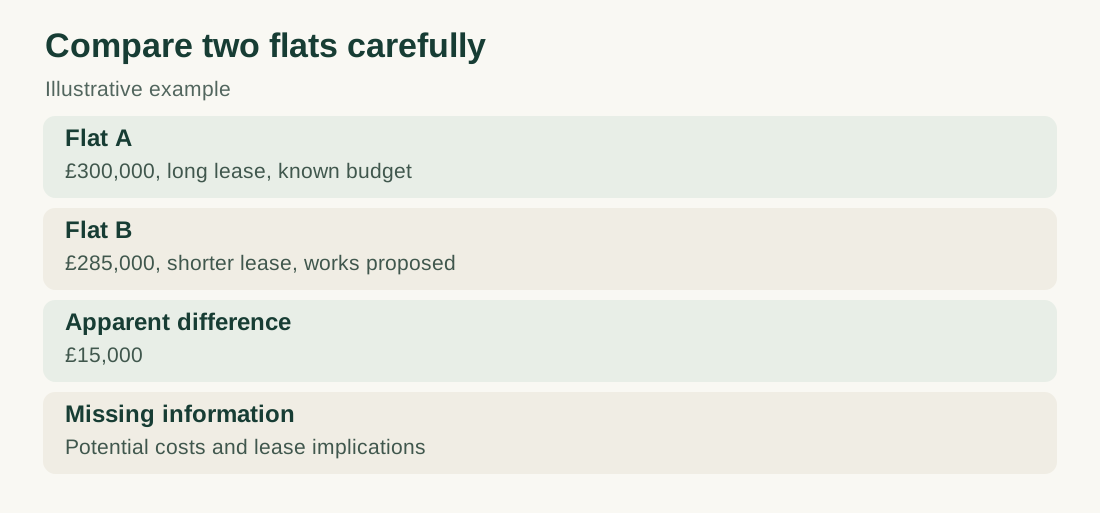
Illustrative example. Flat A is advertised at £300,000 with a long remaining lease and an established maintenance budget. Flat B is advertised at £285,000 but has a shorter lease and a proposed programme of building works with costs not yet confirmed. The £15,000 difference is not enough to conclude which represents better value.
You need the lease documents, relevant building information and advice on the obligations before deciding.
 Illustrative example
Flat A: £300,000, long lease, known budget. Flat B: £285,000, shorter lease, works proposed. Apparent difference: £15,000. Missing information: Potential costs and lease implications.
Treat mortgageability as part of value
Different lenders apply different criteria to lease terms, building characteristics and certain legal provisions. Ask a qualified mortgage adviser or lender about the particular flat rather than assuming that a general lending rule applies everywhere.
If the property cannot be financed on terms suitable for you, its apparent discount may be irrelevant. If you intend to sell later, consider that future buyers may face similar questions.
For the wider comparison process, see how to compare homes before buying. For pre-offer questions, see what to check before making an offer.
Ask for documents before certainty
You may need a lease, service charge accounts, management information and details of proposed works. Some documents arrive during conveyancing, but you can identify obvious unanswered questions before making an offer.
You can read about PMD's buyer report for a home you are considering. A property market estimate cannot replace specialist leasehold conveyancing or a survey.
Before calling a flat good value, compare not only the asking price but the lease, the building's financial position and the likely cost of ownership. The missing documents may matter more than a small discount.
Sources
- HM Land Registry, About the Price Paid Data: Explains completed sale price records and their coverage
- LEASE, Leasehold Advisory Service: General guidance on lease terms and obligations, current rules to verify