
Specialist property valuations
How should you assess the value of a house with an annexe?
An annexe can solve a practical family problem, but its value depends on what it actually provides and how it may be used. Separate the accommodation, the supporting documents and the likely buyer before treating it as extra value.
This is an estimate from comparable sales, not a RICS or mortgage valuation, and not a survey.
Describe the annexe as it exists
Begin with the rooms, access, connection to the main house and services. A bedroom with a bathroom, a detached studio and a self-contained dwelling are not interchangeable descriptions. Their uses may be different even when they have a similar floor area.
Record how the space is used now and what use you are considering. A listing's label does not establish permissions. Ask for the relevant documents and let an appropriate adviser explain their effect.
Planning Portal's England outbuildings guidance distinguishes incidental buildings from separate self-contained accommodation. That is a reason to check the actual position, not to apply a general outbuilding rule to every annexe in England and Wales.
Separate three questions that are often mixed together
What accommodation is present? What use is supported by the documents? Which buyers would find that combination useful? You need all three questions before assessing how a sale of another property helps you.
A kitchen and a separate entrance do not by themselves establish a lawful separate dwelling. Equally, accommodation with a restricted use may still solve a particular household's needs. Neither conclusion supplies a universal premium.
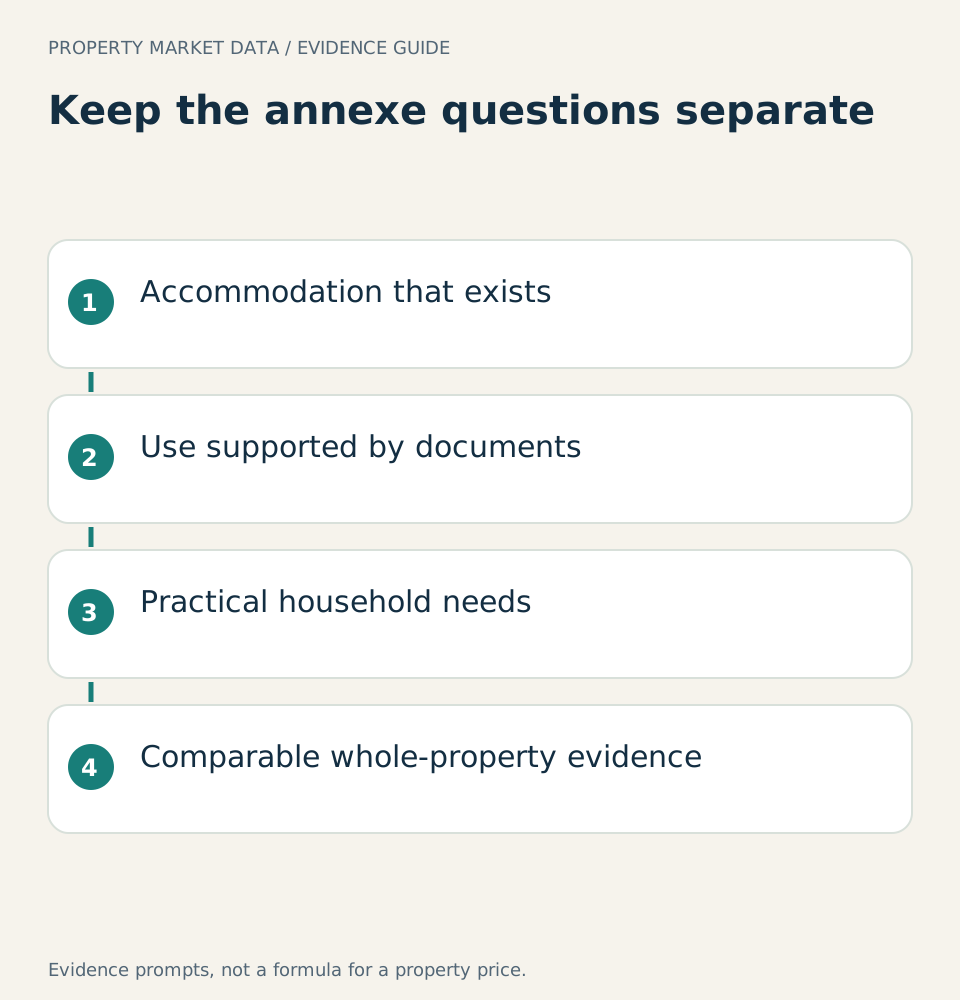
Accommodation that exists; Use supported by documents; Practical household needs; Comparable whole-property evidence. Read the evidence together before making a property-specific judgement.
Ask the seller or agent to identify the evidence behind any rental-income suggestion. Do not include projected income in a price argument merely because the brochure calls the space an annexe. If an income-producing use is material, specialist advice may be necessary.
Look at independence in practical terms
Can someone reach the annexe without crossing the main living space? Is outdoor space shared? What happens with parking, privacy, utilities and maintenance? These are questions about usefulness, not a checklist that automatically increases value.
Walk through the intended daily routine. The arrangement that suits an adult relative may not suit a separate household, a visitor or a buyer who needs a workspace. Describe that difference rather than invent a monetary adjustment.
Compare homes with similar whole-property arrangements
Avoid comparing an annexe solely with a local flat and adding that price to the main house. Separate disposal, ownership and use may not be possible, and the comparison may answer the wrong question.
For the wider approach, read how to assess an unusual home. If the accommodation came from an extension, how an extension can affect a home's estimated value raises different record and layout questions. Keep the annexe-specific facts visible within that assessment.
Read the annexe documents together
| Check | What to establish |
|---|---|
| Permission | Establish the authorised use rather than inferring it from a kitchen. |
| Access | Record how occupants enter and whether access is shared. |
| Services | Check what is separate, shared or dependent on the main home. |
| Buyer comparison | Look for homes offering comparable accommodation and use. |
Describe the annexe as it exists and distinguish that from a proposed use. Someone seeking space for a relative may assess it differently from someone expecting rental income. Do not add an income value to the residential comparison unless that use and its assessment have been established by the appropriate advisers.
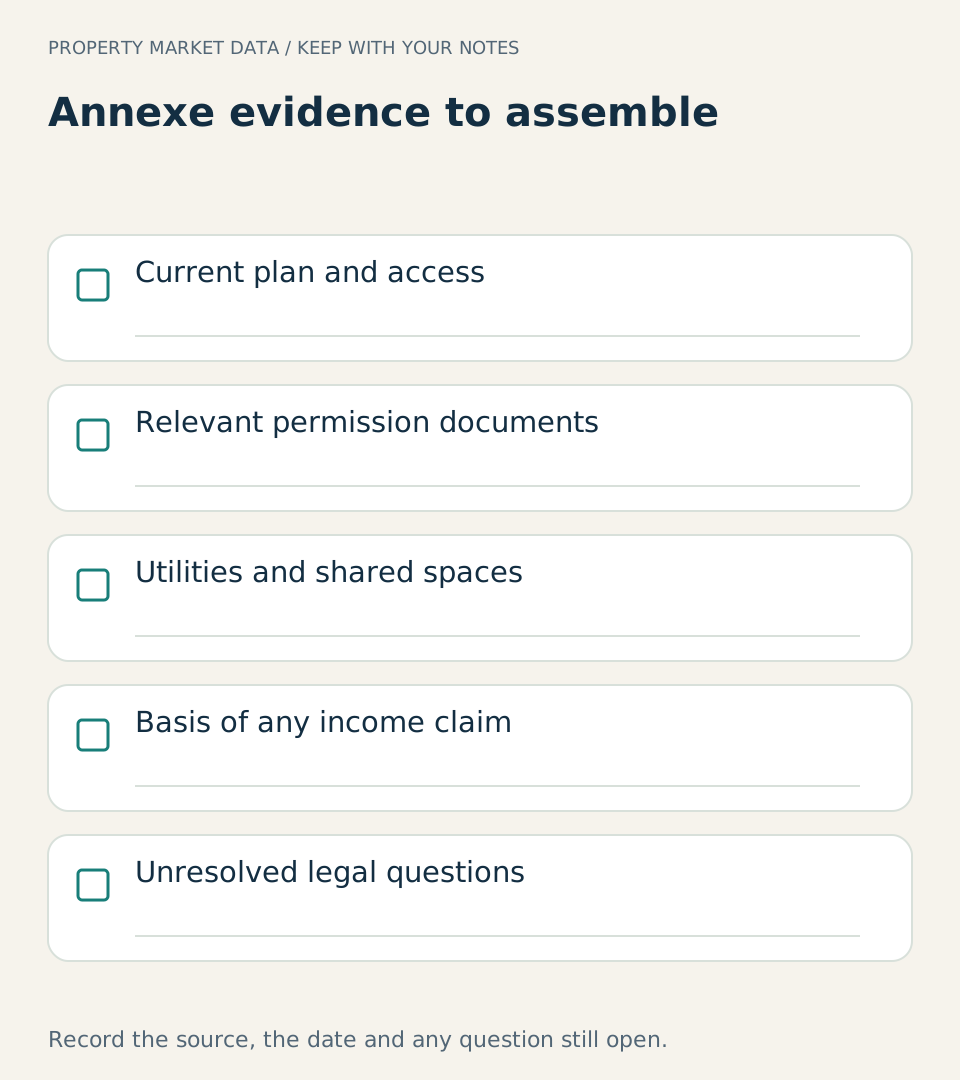
Current plan and access; Relevant permission documents; Utilities and shared spaces; Basis of any income claim; Unresolved legal questions. Record the supporting document and any unanswered question.
If the property also includes land or several outbuildings, use how to assess a house with land. The sale involves a combination of features; isolated component prices can mislead.
Prepare an annexe evidence pack
Collect the plans and available permissions, a factual accommodation description, known service arrangements and questions for the conveyancer. Keep an unresolved item labelled as unresolved. Do not turn a seller's explanation into a legal conclusion.
Ask anyone proposing a price how their selected comparisons account for the annexe's actual arrangement. If no close evidence exists, the uncertainty should be explained rather than hidden by a precise extra-value figure.
Where PMD can help
A PMD report can organise available comparable and local-market evidence. It cannot establish an annexe's lawful use, certify the building or create a separate market value for an assumed dwelling. Read the data limits and confirm suitability before ordering.
A human review may help you interpret your PMD report, within the service's stated scope. Permissions and title questions still belong with the appropriate adviser.
Sources
- Planning Portal, Outbuildings: Incidental outbuildings versus separate self-contained accommodation; England guidance
- Government guidance, Your property boundaries: Title plans usually indicate general rather than exact boundaries