
Selling your home
How should you assess prices when buying and selling at the same time?
When you sell one home and buy another, the important question is often the gap between the two transactions. Each property needs its own evidence. A change in your home's estimate does not tell you what has happened to the homes you want to buy.
This is an estimate from comparable sales, not a RICS or mortgage valuation, and not a survey.
Treat the two markets as separate enquiries
Write down the present home and the type of home you are considering. They may be in different places or appeal to different buyers. Even in one area, their relevant transactions can differ.
A general market headline is therefore background, not a complete assessment of the move. Understanding local house values explains why property mix and boundaries matter when interpreting area statistics.
The government's buying and selling guidance identifies separate transaction stages and professional roles. Keep the two actual transactions in view rather than treat the move as one valuation exercise.
Define the gap using comparable assumptions
Start with an evidence-based view of each property. Ask what supports the sale range and the target purchase price. Use consistent dates where possible and record material differences in the information available.
Do not subtract a cautious purchase estimate from an optimistic asking price and describe the result as the likely cost of moving. An asking price is a strategy, and a purchase budget is not an achieved transaction.
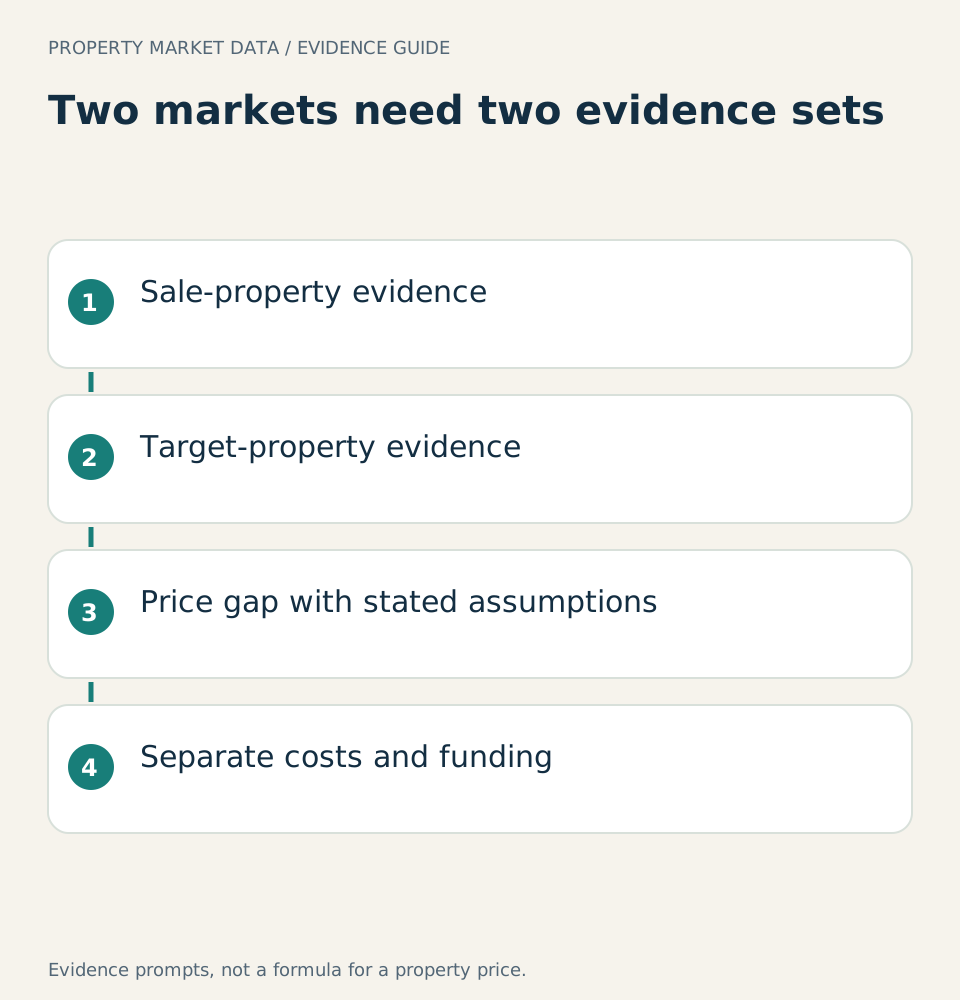
Sale-property evidence; Target-property evidence; Price gap with stated assumptions; Separate costs and funding. Read the evidence together before making a property-specific judgement.
Setting an asking-price strategy is the relevant sale task. Deciding what to offer on a house is the relevant purchase task. Their answers should inform the moving plan without being merged into one arbitrary price rule.
Include the costs separately
Ask the appropriate advisers what costs, commitments and funding arrangements apply to the actual move. Keep quotes and assumptions identifiable. A property-value gap alone is not a full moving budget.
Where timing matters, clarify how the proposed sequence affects the transaction. This article does not recommend bridging finance, a mortgage product or a legal arrangement.
Negotiate the actual decisions
A favourable sale agreement does not establish that a higher offer on another property is justified by market evidence. Equally, a disappointing sale estimate does not automatically mean a cheaper target is available.
Assess each proposal on its own facts, including proceedability and your circumstances. You can then consider the combined decision without pretending the two buyer markets are identical.
Keep both sides of the move visible
| Check | What to establish |
|---|---|
| Sale evidence | Record the expected range and the reasons behind it. |
| Purchase evidence | Assess the next home rather than relying on its asking price. |
| Dependencies | List funding and chain conditions which affect the sequence. |
| Alternatives | Consider what you would change if one side moved differently. |
A stronger selling market does not automatically leave you better placed if the homes you want are also changing in price. Review the two decisions together while keeping their evidence separate. Do not use optimism on one side to conceal uncertainty on the other. Ask the relevant advisers to check financing and timing before making commitments.
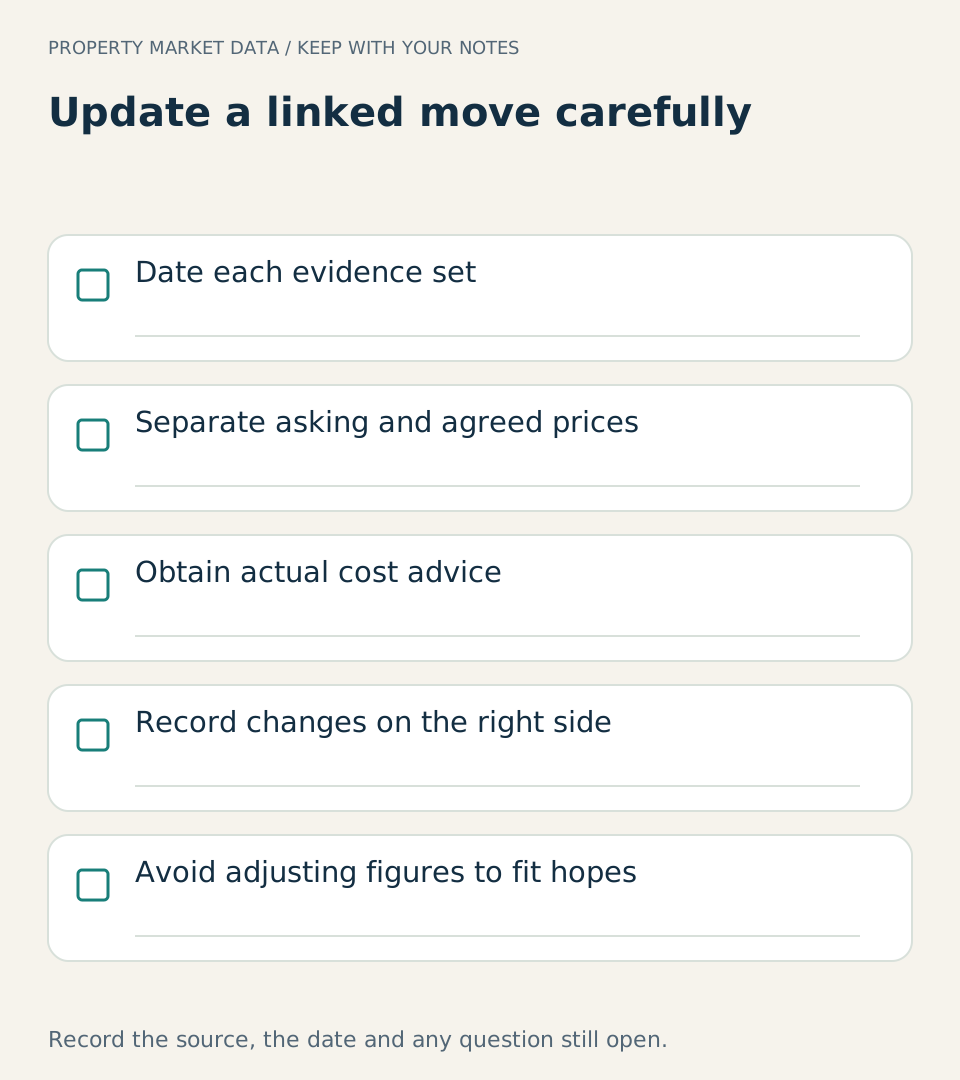
Date each evidence set; Separate asking and agreed prices; Obtain actual cost advice; Record changes on the right side; Avoid adjusting figures to fit hopes. Record the supporting document and any unanswered question.
Review the assumptions when new information arrives
Our recommended record has a line for the sale, the purchase and the movement between them. When a figure changes, identify which evidence changed and what that means for the plan.
If only one side has new information, avoid revising the other side merely to preserve the gap you hoped for. Record uncertainty instead. That creates a more honest discussion with the agent, adviser and other decision-makers.
Keep personal preferences distinct from market evidence. Paying more for a home that suits you may be a conscious decision, but it should not be labelled as an evidence-backed discount if it is not one.
Use PMD for each eligible property separately
PMD can organise sales and local context for the home you are selling. A buyer report can address a particular home you are considering. The two outputs have separate property evidence and limitations.
Read the report scope before deciding what each contributes. It cannot establish financing or promise that your preferred price gap will be achieved.
For a target home, explore the buyer report. A useful plan connects two clearly described property decisions with actual cost and professional information. It does not rely on a single market percentage to make the move work.
Sources
- Government guidance, How to buy a home: Purchase evidence, funding, conveyancing and transaction stages
- Government guidance, How to sell a home: Estate agent appraisals, selling preparation and checking service scope
- MoneyHelper, Mortgage fees and moving costs: Lender valuation purpose and separate moving-cost categories